Physical Address
304 North Cardinal St.
Dorchester Center, MA 02124
Physical Address
304 North Cardinal St.
Dorchester Center, MA 02124

Updated October 2026
A business structure is the legal form a business takes: a sole proprietorship, partnership, LLC [limited liability company], or corporation. It decides who is personally responsible for the company’s debts, how its profits are taxed, and how much paperwork you owe every year. Pick well and it fades into the background. Pick carelessly and you may find your house is part of a lawsuit you thought only involved the business.
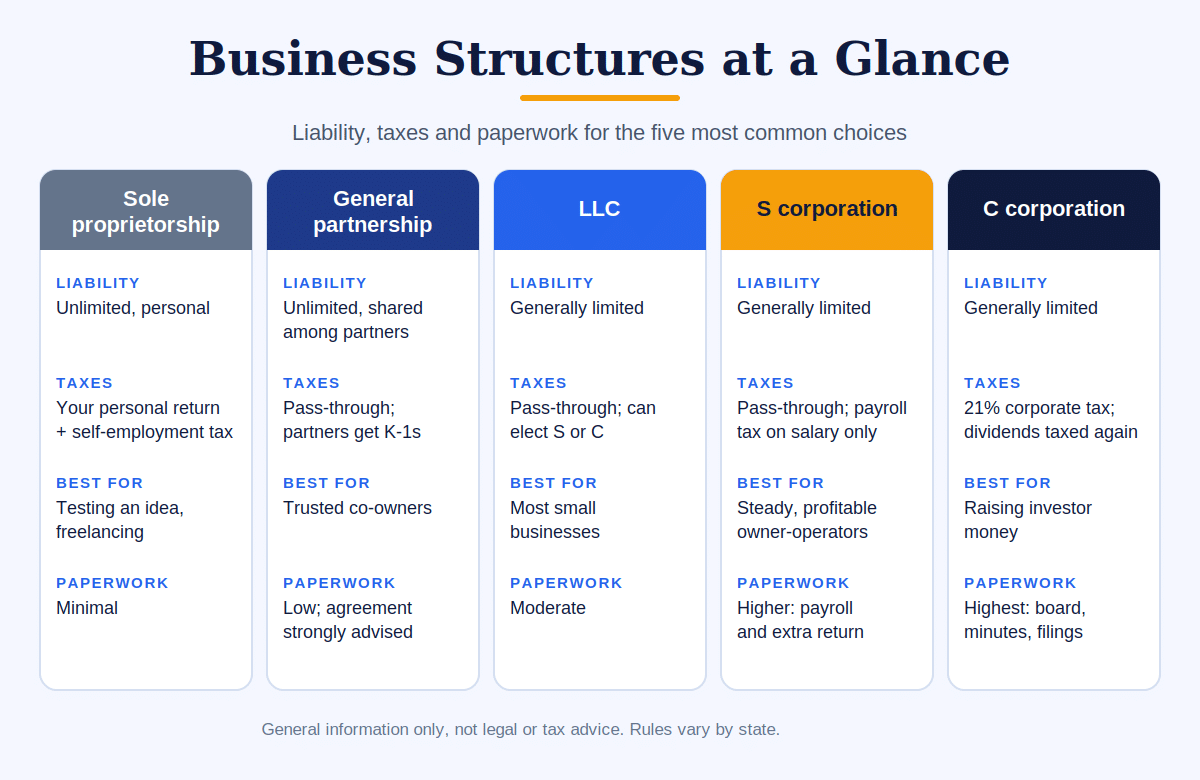
Here are the five structures most small business owners choose between, in one glance:
Most guides list four or five core types, and the count depends on how the author slices things. Some group S and C corporations under a single “corporation” label and land on four. Others separate them and get five. Add limited partnerships (LPs), limited liability partnerships (LLPs), benefit corporations and nonprofits, and you reach seven or more. The five above cover what nearly every small business owner will actually choose between, and the SBA’s own comparison chart works from the same list.
Because it quietly answers three questions you will care about a great deal later.
Who pays if things go wrong? Under some structures, a lawsuit or an unpaid supplier invoice can reach your personal savings, your car, even your home. Under others, the business takes the hit and your personal assets generally stay out of it.
How are you taxed? Some structures send all profit straight to your personal tax return. Others make the business pay tax first. The difference can run to thousands of dollars a year.
How much administration can you stomach? A sole proprietor can run a business from a laptop and a folder of receipts. A corporation needs bylaws, meeting minutes and a stack of annual filings. Neither is wrong. They are different amounts of homework.
The U.S. Small Business Administration recommends choosing your structure before you register your business, because it affects which forms you file, which tax options you have, and sometimes your business name.
| Structure | Personal liability | How it’s taxed |
|---|---|---|
| Sole proprietorship | Unlimited | Your personal return (Schedule C), plus self-employment tax |
| General partnership | Unlimited, shared among partners | Pass-through; partners get Schedule K-1s |
| LLC | Generally limited | Pass-through by default; can elect S or C corp treatment |
| S corporation | Generally limited | Pass-through; owner-employees pay payroll tax on salary |
| C corporation | Generally limited | Corporation pays 21%; dividends taxed again |
“Generally limited” is carrying weight in that table. Liability protection has exceptions, which the LLC section below explains.
Almost always, yes. If you start selling something and haven’t filed anything to become a different kind of business, you are a sole proprietor. No forms, no state filing fee, no ceremony. Plenty of people are sole proprietors for months before they realize it.
Liability: unlimited and personal. You and the business are legally the same person, so business debts and lawsuits can come after your own assets.
Taxes: profit is reported on your personal return, usually on Schedule C, and you pay self-employment tax [the self-employed person’s version of Social Security and Medicare taxes] on top of regular income tax.
Good for: testing an idea, freelancing, low-risk side businesses.
Watch out for: the day real money or real risk shows up. A client dispute is a calmer affair when your home isn’t part of it. It can also be harder to get a business loan or build business credit when you and the business are the same entity.
If you operate under a name other than your own, you will usually register a DBA [doing business as, also called a trade name or fictitious name] with your state or county. Local licenses and permits apply whatever structure you choose.
Then you are a general partnership by default, whether or not anyone wrote anything down. Two friends who open a bakery and split the profits are partners in the eyes of the law.
Liability: each partner is typically liable for the business’s debts and can be held responsible for what the other partners do on the business’s behalf. Choosing a partner is also, quietly, choosing who can sign you up for a debt.
Taxes: a partnership is a pass-through entity [the business itself generally pays no federal income tax; profits and losses flow through to the owners’ personal returns]. The partnership files an information return (Form 1065) and gives each partner a Schedule K-1 showing their share.
Good for: professional practices and small ventures with trusted co-owners.
Watch out for: skipping the partnership agreement. Who contributes what, who decides what, and what happens when someone leaves are much easier conversations before there is money on the table.
Two variations exist. In a limited partnership (LP), at least one general partner carries unlimited liability while limited partners are exposed only up to their investment. In a limited liability partnership (LLP), partners are protected from each other’s negligence, though each stays responsible for their own actions. LLPs are common among law, accounting and medical practices. Availability and rules vary by state.
Because it offers a rare combination: protection for your personal assets, moderate paperwork, and tax flexibility. You form an LLC by filing articles of organization with your state, and the law then treats the company as a separate legal entity. Owners are called members. For the full walkthrough, see what is an LLC.
Liability: members are generally not personally responsible for the LLC’s debts. “Generally” is doing real work in that sentence. You remain liable for your own wrongdoing and for anything you personally guarantee (many small business loans require this), and a court can disregard the LLC’s protection if you mix personal and business money, a move known as piercing the veil. A separate business bank account prevents most of that trouble.
Taxes: by default, a single-member LLC is taxed like a sole proprietorship and a multi-member LLC like a partnership. An LLC can also elect to be taxed as an S corporation or a C corporation. The LLC is the legal wrapper; the tax treatment is a choice.
Good for: most small businesses that want liability protection without corporate formalities.
Watch out for: state costs and upkeep. Fees vary widely, many states require an annual report, and you will need a registered agent (a person or service that receives legal papers on the company’s behalf). An operating agreement, the document that sets out how the LLC is run, isn’t required in every state but is worth having, especially with more than one member.
Weighing an LLC against going it alone? Our comparison of LLC vs sole proprietorship goes through the trade-offs.
First, a clarification that trips up a surprising number of people: an S corporation is not a different kind of company. It is a tax election. A corporation or an LLC can ask the IRS to be taxed as an S corp by filing Form 2553. The deadline is two months and 15 days after the start of the tax year the election should take effect (March 15 for a calendar-year business), and you can also file any time during the preceding tax year. If approved, the business’s profits pass through to the owners’ personal returns instead of being taxed at the company level.
So why bother? Because of how owners get paid. If you work in your S corp, you must pay yourself a reasonable salary, which is subject to payroll taxes. Profit beyond that salary can be taken as distributions, which aren’t subject to self-employment tax. For a business with healthy, steady profit, that can mean real savings. The tax section below puts numbers on it.
The savings come with strings:
For most new businesses, the extra admin outweighs the savings until profit is consistently solid, and an accountant can run the numbers on your actual figures.
Possibly, but usually for a specific reason. A C corporation is a separate legal and tax entity owned by shareholders. It pays its own federal income tax at a flat 21%. When it then pays profits out as dividends, shareholders pay tax on them again. That’s the famous double taxation, and it’s the main reason small, owner-run businesses often skip this structure.
So why does anyone choose it? Because the C corp does things the others can’t, or can’t as cleanly:
If you plan to raise a priced round from professional investors, you will likely end up here, and many startups incorporate in Delaware for its well-developed corporate law. If you’re opening a plumbing business and don’t plan to sell shares to anyone, you probably won’t.
Watch out for: formalities. A corporation needs bylaws, a board of directors, shareholder and board meetings, and records of each. Skipping them is how owners lose the liability protection they paid for.
Two more options appear on SBA and state lists. A benefit corporation is a state-recognized corporate form that commits the company to a public benefit alongside profit. It is not the same as B Corp certification, which is a separate credential awarded by a nonprofit called B Lab. A nonprofit corporation is formed for charitable, educational or similar purposes and can apply for tax-exempt status, but it cannot distribute profits to owners. Both are specialist choices.
Most of the real-money differences come down to three ideas: pass-through taxation, self-employment tax, and double taxation.
Pass-through taxation means the business pays no federal income tax itself. Profit flows to each owner’s personal return and is taxed at that owner’s individual rate. Sole proprietorships, partnerships, LLCs (by default) and S corporations all work this way.
Self-employment tax is where pass-through treatment gets expensive. The rate is 15.3%: 12.4% for Social Security and 2.9% for Medicare. The Social Security portion applies only up to an annual wage base, which is $184,500 for 2026, while the Medicare portion has no cap. Higher earners owe an additional 0.9% Medicare tax above certain income thresholds. Half of your self-employment tax is deductible when you calculate your income tax. Sole proprietors and LLC members taxed as partnerships pay it on their net earnings.
Double taxation belongs to C corporations: the company pays 21% on its profit, and shareholders pay again on dividends. For startups that plan to reinvest for years before paying anything out, the second layer is often theoretical for a while, but it’s worth understanding before you incorporate.
Here is what the S corp election can do, with deliberately simple numbers. Say your business earns $120,000 in profit and the IRS would accept $60,000 as a reasonable salary for your work:
That’s a gap of roughly $7,800 a year on paper. Real life shrinks it. Payroll processing, a separate tax return and state rules all take a bite, and a lower salary also shrinks the pay that retirement plan contributions are based on. So does the QBI deduction, explained below: your salary doesn’t qualify for it, so in this example the S corp’s deduction would be roughly half the sole proprietor’s, assuming income below the phase-out thresholds. It’s an illustration of why the election exists, not a forecast for your business.
On the QBI deduction: the federal qualified business income deduction lets many sole proprietors, partners, LLC members and S corp owners deduct up to 20% of their qualified business income. It was made permanent in 2025. Income limits and special rules for certain service businesses apply, and C corporations can’t claim it.
There is one catch for S corp owners. The salary you pay yourself is a business expense, and wages don’t count as qualified business income, so only the profit left after salary earns the deduction. A sole proprietor’s entire net profit can qualify, which is why the S corp’s tax advantage is smaller than the payroll-tax math alone suggests.
An EIN [Employer Identification Number, your business’s federal tax ID] is needed by partnerships, corporations and multi-member LLCs. Many sole proprietors and single-member LLC owners get one anyway for banking and hiring. Getting an EIN from the IRS is free.
State fee schedules change, so check your Secretary of State’s website for current figures before you file. Formation services charge their own fee on top of the state’s.
Run through four questions, in this order.
1. How much personal risk are you carrying? A freelance writer and a roofing contractor face very different odds of being sued. The higher the risk, the stronger the case for liability protection (LLC or corporation).
2. How much profit will the business make? Modest or uncertain profit usually points to the simpler, cheaper structures. Steady, strong profit makes tax-driven choices like the S election worth modelling.
3. Who is involved, now and later? Partners need an agreement and protection from one another. Outside investors may require a C corp. A solo owner has the most freedom.
4. How much administration will you actually keep up with? Be honest here. A structure you maintain badly can be worse than a simpler one you maintain well.
These are patterns, not prescriptions. Taxes and liability depend on your state, your business and your numbers, and an hour with an accountant or attorney tends to cost far less than fixing a bad choice later. SCORE and Small Business Development Centers also offer free or low-cost advising.
A freelancer or solo consultant. A sole proprietorship is the simplest option, and many start there. An LLC adds liability protection for modest cost and effort, and if profit grows steady, an S corp election may be worth modelling.
Two co-owners or a family business. A multi-member LLC with a written operating agreement is the common choice. It avoids the shared personal liability of a default general partnership and allows flexible profit-sharing without corporate formalities.
A higher-risk business such as construction or food service. When injury, property damage or large claims are realistic, prioritize liability protection with an LLC or corporation. Neither protects you from liability for your own negligence, so insurance still matters.
A licensed professional practice (law, medicine, accounting). Many states restrict how licensed professionals can organize. You may be required to use a professional LLC (PLLC), professional corporation (PC) or an LLP, with ownership limited to licensed practitioners. Check your state licensing board before filing anything.
A startup planning to raise venture capital. A C corporation, typically formed in Delaware, is the usual choice. Investors expect it, and it handles multiple stock classes and employee options cleanly.
It can. Sole proprietorships and general partnerships run on default rules, but LLCs and corporations are created by filing with a state, and each state sets its own fees and ongoing requirements.
The spread is wide. Filing fees range from about $35 in Montana to $500 in Massachusetts. California charges LLCs and corporations an $800 minimum annual franchise tax on top of its filing fee. Delaware, a popular home for corporations, has its own annual taxes. Some states let you form a company anywhere, but you will generally have to register as a “foreign” company [meaning one formed in another state] where you actually operate, which means paying twice.
One recent change is worth knowing. For a while, the Corporate Transparency Act required many new LLCs and corporations to report their owners to FinCEN, the Treasury’s financial crimes bureau. That requirement no longer applies to U.S.-formed companies: FinCEN’s rule, finalized in August 2026, exempts domestic companies and their U.S. owners. If an older guide tells you to file a beneficial ownership report, it’s out of date. Rules can change, so confirm on FinCEN’s site before you file or skip anything.
It can. Lenders generally look for formation documents, an EIN and a clear separation between the owner and the business, and an LLC or corporation presents that more cleanly than a sole proprietorship does. A separate legal entity can also build its own business credit profile over time. That said, small business lenders often ask owners to sign a personal guarantee anyway, so forming an LLC won’t always wall your personal finances off from a loan.
Yes, and plenty of businesses do. The common path runs from sole proprietorship to LLC, then perhaps an S corp election, and sometimes a conversion to a C corporation when outside investors appear. Taxes are the usual trigger, with liability protection and investor credibility close behind.
It isn’t free. Changing structure can mean new state filings, a new EIN, updated bank accounts, contracts and licenses, and sometimes tax consequences worth running past an accountant first. Moving out of a C corporation is the trickiest direction: converting it to an LLC is generally treated as a liquidation, which can be taxable, and electing S status later can trigger a built-in gains tax on appreciation that built up during the C corp years. That is one of the better arguments for thinking about your structure early rather than improvising later.
In a different sense, yes. Organizational structure describes how people and responsibilities are arranged inside a company, not how the company is legally formed. The common types:
A one-person business doesn’t need an org chart, but it does need a legal structure, and most growing companies end up needing both. For the people side, see : people, process, technology.
Choosing a business structure is less about paperwork than about risk, tax and growth. Start with how much personal exposure you can live with, then match the structure to how you earn and who is involved. For many small businesses the answer today is a sole proprietorship or an LLC, and when your situation changes, the structure can change with it.
This article is general information, not legal or tax advice. Rules vary by state and change over time; consult a qualified attorney or CPA about your situation.