Physical Address
304 North Cardinal St.
Dorchester Center, MA 02124
Physical Address
304 North Cardinal St.
Dorchester Center, MA 02124

I have bought three different project management tools in eighteen months. Each one arrived with the same promise: finally, my scrappy little content team would stop losing blog drafts in group chats and missing deadlines because nobody remembered whose turn it was to fact-check the guest post. Each one failed for the same reason. I was buying technology to fix a problem that was actually about people and process, and no amount of drag-and-drop Kanban boards was going to change that.
Sound familiar? If you’ve ever thrown money at a shiny new app hoping it would magically fix a team that was already disorganized before the app showed up, you’ve run headfirst into a wall that’s been documented since before most of us were born. It’s called the people, process, technology framework, and once you understand it, you start seeing your own version of my tool-hopping problem everywhere.
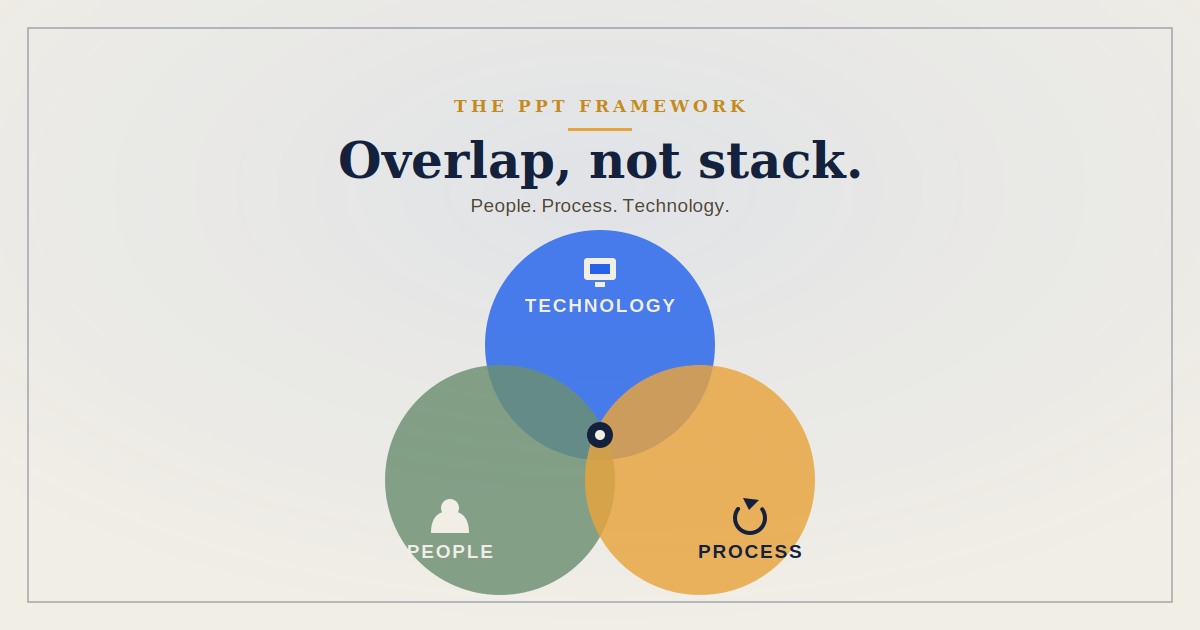
Strip away the consulting-deck language and the idea is almost insultingly simple: any business runs on three moving parts. People are the humans doing the work and making the calls. Process is how the work actually gets done, step by step, whether or not anyone bothered to write it down. Technology is whatever tools, software, or systems support that work.
The framework’s whole argument is that these three legs have to be roughly the same length, or the stool tips over. Hire brilliant people and give them no process, and you get chaos dressed up as flexibility. Build an airtight process and hand it to a team you never trained on it, and you get quiet resentment and workarounds. Buy the best software on the market and skip the first two steps entirely, and you get exactly what happened to me: three abandoned subscriptions and a team that’s back to tracking deadlines in a group chat.
Why does this three-way balancing act matter more than picking “the best” tool or hiring “the best” people? Because a business isn’t a collection of good parts. It’s a system, and systems fail at their weakest link, not their strongest one.
This isn’t a framework some SaaS company invented to sell you a demo. Business scholar Harold Leavitt introduced the underlying idea back in 1965, in a paper called “Applied Organizational Change in Industry.” His original version, known as Leavitt’s Diamond, had four points instead of three: structure, people, tasks, and technology. Over the following decades, structure and tasks got folded together into what we now call “process,” and the diamond became a triangle- sometimes called the golden triangle, sometimes the three-legged stool, depending on which consultant is drawing the whiteboard.
What’s notable is how little the core idea has changed while everything around it has. Leavitt was writing about factory floors and early mainframes. We’re applying the exact same logic to Slack channels and AI copilots. The tools got faster. The reason businesses trip over themselves did not.
Here’s where most explanations of this framework get too abstract to be useful, so let’s make it concrete. There’s a fairly predictable failure pattern, and it almost always starts with skipping straight to technology.
Notice the pattern? In every failure mode, the fix isn’t “get better people” or “buy better tech.” It’s sequencing. People first, because they’re the ones who’ll actually use whatever comes next. Process second, because it defines how the work should flow. Technology last, because its only job is to make an already-working process faster.
“People” covers more than headcount. It’s the skills your team actually has versus the skills the job requires, how decisions get made and by whom, and whether anyone feels safe flagging that a process isn’t working. A five-person business can be just as misaligned on the “people” leg as a five-thousand-person one- the difference is that in a small business, one disengaged hire is a much bigger percentage of your total capacity.
The uncomfortable question worth asking here: if you disappeared for a month, would your team know what to do, or would everything route back to you by default? If it’s the latter, that’s not a people problem you solve by hiring. It’s a signal the other two legs of the stool are missing.
Not if it’s done right. A process is simply the honest answer to “what actually happens, in what order, when this task needs doing?” Most small businesses have processes whether or not they’ve ever written them down, they just live entirely inside one person’s head, which is a single point of failure with a name and a two-week vacation.
Documenting a process isn’t about adding red tape. It’s about making the invisible visible, so it can be improved, delegated, or automated instead of quietly depending on tribal knowledge. The businesses that get “process” wrong usually do it in one of two directions: no process at all, so quality depends entirely on who happens to handle the task that day, or so much process that employees spend more time filling out forms than doing the work the forms were meant to support.
Technology is the amplifier, not the fix. It takes whatever is already true about your people and process and makes it faster and more visible for better or worse. A well-trained team with a clear process will get real leverage out of new software. A disorganized team with no process will just make the same mistakes at a higher volume, with a monthly subscription fee attached.
This is also where the “we need an AI strategy” pressure tends to hit small business owners hardest. AI tools are extraordinary amplifiers. Pointed at a genuinely well-run process, they can save a small team real hours. Pointed at chaos, they automate the chaos.
Most breakdowns of this framework reach for enterprise case studies — Toyota’s manufacturing floor, an insurance company’s claims software rollout. Useful, but not exactly how it plays out when your whole company is twelve people and a shared inbox. A few more familiar versions:
The common thread: none of these were technology problems on the surface, even though technology was where the money and frustration ended up going.
A few reliable tells that one leg of the stool is shorter than the others:
If more than one of those sounds familiar, the fix probably isn’t more software. It’s going back to the first two legs.
The framework is easy to nod along to and genuinely difficult to act on, so here’s a version scaled for a business without a change-management department:
It’s a fair challenge to throw at a model built for 1960s factory floors. But if anything, the rise of AI tools has made the framework more relevant, not less, because AI is the purest example yet of technology that does nothing on its own. It needs a process to plug into and people who understand how to direct it. The businesses getting real value out of AI right now aren’t the ones with the flashiest tools. They’re the ones that had a working process to point the tool at in the first place.
Somewhere around my second abandoned project management tool, I finally stopped asking “which app will fix this?” and started asking “what are we actually trying to get right, in what order, before anyone touches software?” The people, process, technology framework isn’t a diagram you build once and frame on the wall. It’s a habit of asking that same question every time something in your business feels harder than it should, and resisting the very tempting, very expensive urge to buy your way past a people or process problem instead of solving it.
The tool you’re eyeing right now might genuinely be the right one. But it’s worth finding out whether it’s actually the next step, or just the fourth subscription in your own version of my eighteen-month experiment.