Physical Address
304 North Cardinal St.
Dorchester Center, MA 02124
Physical Address
304 North Cardinal St.
Dorchester Center, MA 02124

I found out I was my own registered agent the hard way, three months after forming my LLC, mid-flight, when a neighbor texted asking why a stranger in a lanyard had been standing on my porch with a clipboard for twenty minutes. Turns out “registered agent” doesn’t mean “generally reachable.” It means being physically present at that address during business hours, indefinitely, like a very boring doorman.
I got lucky, just an annual report reminder, not a lawsuit. But it raised the obvious question: what exactly had I volunteered for, and why does every state require it?
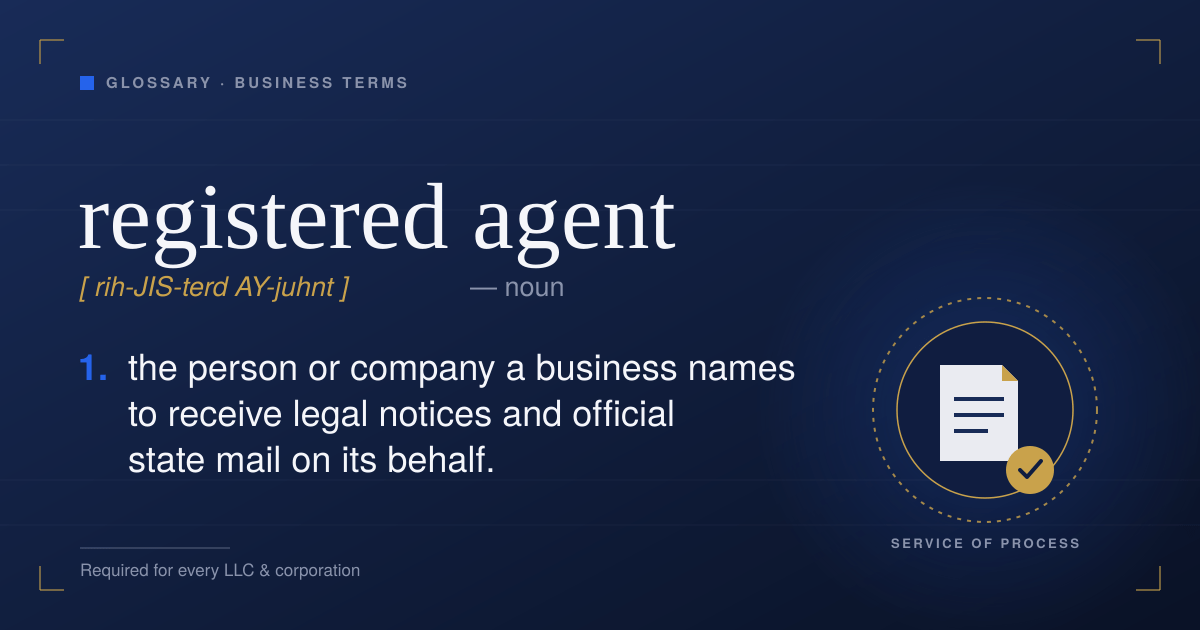
Strip away the legalese and a registered agent is simply the person or company your business designates to receive official mail on its behalf – specifically, service of process (the fancy term for “you’re being sued, here are the papers”), plus state correspondence like annual report notices, tax documents, and compliance reminders.
Depending on which state you’re in, you might see this role called a resident agent, a statutory agent, or an agent for service of process. Different label, same job: be a reliable, known point of contact so that if your business ever needs to be officially notified of something, there’s no ambiguity about where that notice goes.
It’s worth separating this from your business’s main office. Your registered agent’s address – sometimes called your registered office – doesn’t have to be where you actually work. It just has to be a real street address (no P.O. boxes) in the state where your business is registered, staffed by someone who’ll actually be there to receive documents.
Here’s the part that surprised me: this isn’t a nice-to-have or a service upsell. Every state requires LLCs and corporations to name a registered agent at the time of formation, and to keep that information current for as long as the business exists.
The logic traces back to due process. Courts need a dependable way to notify a business if it’s party to a legal action otherwise, in theory, a company could dodge a lawsuit indefinitely just by being hard to find. The registered agent exists to close that loophole.
In most states, yes – if you meet a fairly specific checklist: you need to be at least 18, you need a physical street address in the state where your business is registered, and you need to be available at that address during standard business hours, every business day, indefinitely. Note the “you,” too – in many states, the business itself can’t act as its own registered agent. It has to be a natural person or a company authorized to provide the service.
On paper, doing it yourself costs nothing. In practice, it comes with trade-offs people don’t think about until they’ve lived them:
This is where the stakes stop being theoretical. If your registered agent, whether that’s you or a service, fails to receive or forward a legal notice, your business can lose a case by default without ever knowing it was sued. Courts don’t wait for you to check your mail; if proper service was attempted at your registered agent’s address on file, that’s generally considered sufficient, whether or not the message actually reached you.
There’s a broader compliance angle too: states use your registered agent’s address to send annual report reminders and renewal notices. Miss enough of those, and you risk falling out of good standing or, eventually, administrative dissolution – the state essentially shutting your business down on paper for failing to keep up with its own upkeep.
If you serve as your own agent and meet the requirements, it’s free. That’s the appeal, and for a lot of very small, home-based businesses, it’s a perfectly reasonable choice.
If you’d rather not be legally tethered to your porch, commercial registered agent services generally run somewhere between $99 and $300 a year, depending on what’s bundled in – some just forward mail, while pricier tiers add compliance deadline tracking, document scanning, and multi-state coverage if you’re registered to do business outside your home state. A word of caution worth passing on: a lot of providers offer a free or heavily discounted first year bundled with LLC formation, then quietly renew you at their standard rate. Read the renewal terms before you sign up for anything, not after your card gets charged.
Is it worth paying? That depends on how much you value privacy, how often you travel, and honestly, how much you trust yourself to never once be late picking up the mail.
If you decide a paid service makes sense, a few things are worth comparing before you commit:
Every business with an LLC or corporate structure needs one, that part isn’t optional. Whether that agent is you, standing by your mailbox with unnerving dedication, or a service that handles it while you’re off doing literally anything else, is the only real decision left to make.
I switched to a paid service after my airport-clipboard scare. Not because it was legally required – being your own agent is perfectly legitimate – but because I decided my business’s legal standing shouldn’t depend on whether I happened to be home on a Tuesday afternoon.