Physical Address
304 North Cardinal St.
Dorchester Center, MA 02124
Physical Address
304 North Cardinal St.
Dorchester Center, MA 02124

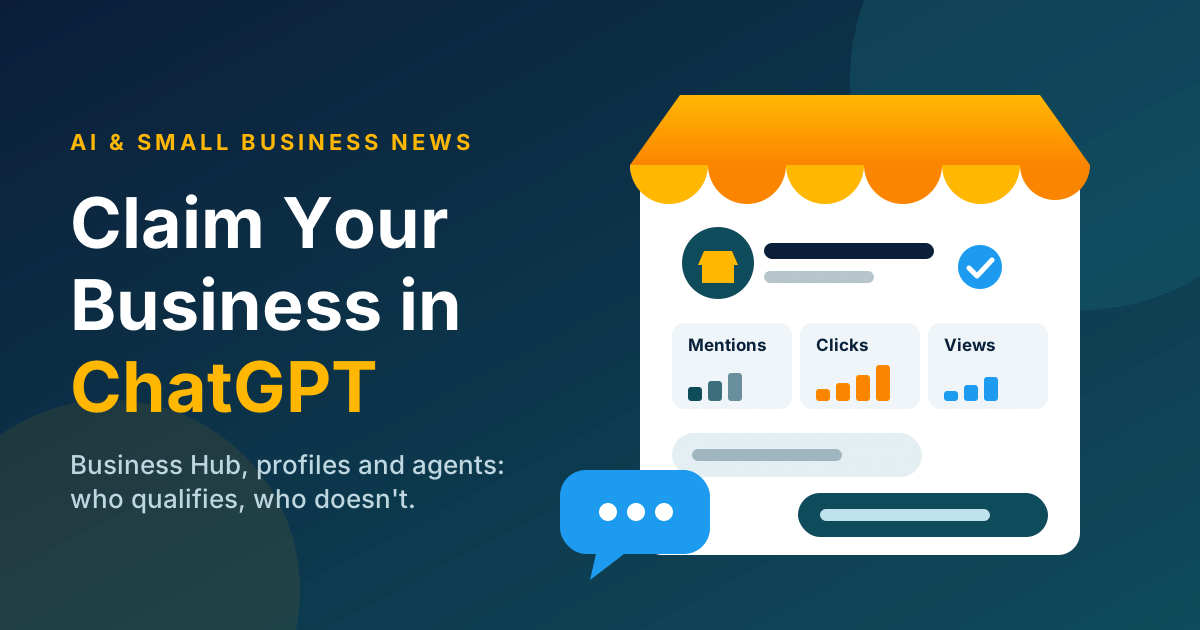
OpenAI announced on Tuesday, November 10, that companies can now claim their business inside ChatGPT, correct what the chatbot says about them, and see how often it mentions them. The beta program, called Businesses in ChatGPT, targets the 1.2 billion people OpenAI says use ChatGPT each week.
It comes with a catch. Part of it is open to businesses almost everywhere ChatGPT operates, and part of it is limited to a narrow slice of U.S. companies.
It has two parts. The first is Business Hub, a dashboard where a company can claim its profile. Once verified, it can update key details and upload self-service product feeds (structured lists of your products with current prices and availability), so ChatGPT works from your facts rather than its best guess.
The second is Business Agents. These are chatbots a business builds, tests and launches. When a business shows up in a ChatGPT answer, a user can click through to its profile and start a conversation with its agent. A shopper comparing two products, for example, could ask how they differ and which one fits their needs.
OpenAI says the agent conversation is labeled, kept separate from the user’s original chat, and distinct from ChatGPT’s own answers.
Business Hub is open to eligible businesses wherever ChatGPT is available. Existing OpenAI Enterprise customers and advertisers can go through their OpenAI representative, and Shopify merchants can connect their store from Business Hub or the Shopify admin to speed up verification.
Business Agents are the restricted part. OpenAI says they’re available for now only to eligible ecommerce and online service businesses in the United States.
Even that may be narrower in practice. SEO consultant Aleyda Solis, founder of Orainti, wrote on X that the rollout appears to cover only local businesses, meaning those with physical stores or offices open to customers, and online stores. “Not yet service focused businesses yet,” she said. “Hopefully soon.”
Freelancers, consultants and agencies should check their category before assuming they’re in.
Business Hub reports how many times your business is mentioned and how many website clicks it gets. It also lists “discovery topics,” the themes that come up in conversations where ChatGPT cites your site.
On privacy, OpenAI says it doesn’t share users’ conversations or Business Agent chats with businesses. Insights are aggregated and appear only once enough conversations meet certain thresholds, so a small business may see little at first.
Sort of, and this is the part worth watching. Businesses can sponsor their Business Agent and use it as the destination for ChatGPT Ads. OpenAI says sponsored placements are clearly labeled and separate from ChatGPT’s responses.
Digiday reported that Business Hub and Business Agents are free at launch, and that OpenAI’s vice president of monetization, Benji Shomair, did not rule out a paid model later. OpenAI hasn’t announced pricing.
Will users notice the line between a paid agent and an organic answer? That’s the open question.
You don’t need to build an agent this week. But a few steps cost little:
OpenAI calls this an early step. It says it plans to bring Businesses in ChatGPT and Business Agents to more markets and categories, and to build tools for organizations with more complex needs. It will also explore other ways for businesses to reach customers, directly or through agents, in ChatGPT and beyond.