Physical Address
304 North Cardinal St.
Dorchester Center, MA 02124
Physical Address
304 North Cardinal St.
Dorchester Center, MA 02124

I once tried to keep a surprise birthday party secret for exactly four days. By day two, my Slack status said “planning something big,” my browser history was a highlight reel of balloon arch tutorials, and the guest of honor had already asked, gently, if she should practice looking surprised. Secrecy, it turns out, is not my strong suit.
So when I first learned that entire companies, with employees, funding, and office leases, manage to stay invisible for years, I felt a mix of awe and deep personal inadequacy. How does an organization pull off what I couldn’t manage for a long weekend? Welcome to the world of the stealth startup, where founders are betting that saying nothing is the smartest thing they can say.
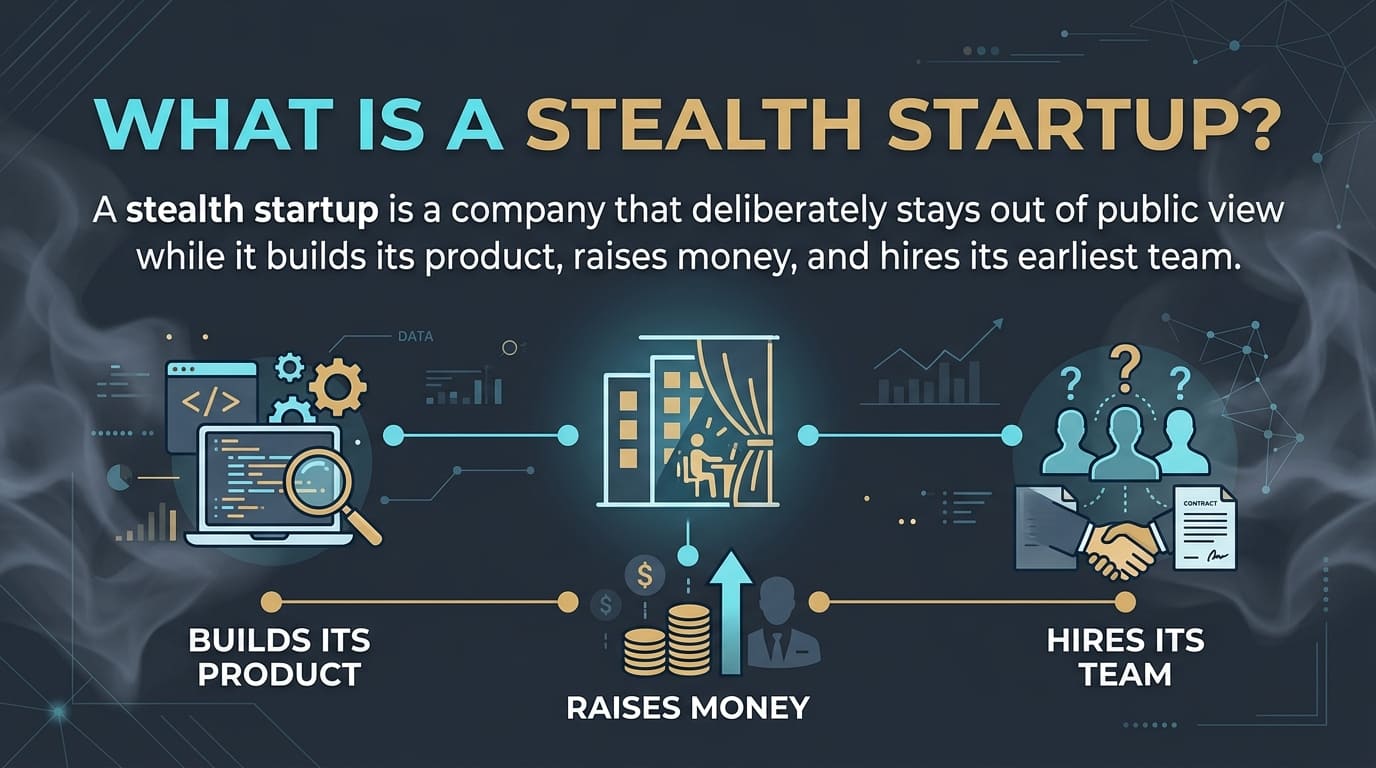
A stealth startup is a company that deliberately stays out of public view while it builds its product, raises money, and hires its earliest team. No website worth reading. No press releases. No LinkedIn post announcing anything.
That’s the one-line version. In practice it looks like a name (often a placeholder), a locked office door, and a lot of quiet work happening where nobody’s watching. This period of deliberate invisibility is usually called stealth mode [a temporary phase where a company hides its activities, product, or even its existence from the public until it’s ready to launch]. It isn’t the same as simply being small or unknown. A stealth startup chooses obscurity as a strategy, the way a poker player chooses not to show their hand until the pot is worth showing up for.
Why go to the trouble? Mostly one of three reasons: to keep competitors from copying an idea before it’s built, to protect intellectual property while patents and prototypes are still in progress, or to control the story so the eventual big reveal actually lands as a big reveal.
Here’s the part that surprised me most. Stealth isn’t really about paranoia so much as timing. Announce what you’re building too early, and you’ve handed every competitor, journalist, and skeptic on the internet a chance to react to it before you’re ready, copy it, or simply beat you to market. Stay quiet, and you keep that element of surprise for exactly as long as you need it.
There’s also a quieter, less dramatic reason: stealth buys founders room to fail in private. Building a product is messy. Early versions are often bad. Nobody wants their half-finished, buggy prototype dissected on a tech blog before it’s ready for the world.
Stealth mode sounds abstract until you see who’s used it. A few well-documented examples make it concrete:
Notice the pattern? Most of these aren’t first-time founders rolling the dice. Stealth tends to be a move made by people who’ve already built something real once. Investors are essentially betting on the person, since there’s no product demo to evaluate.
Not every “quiet” startup is equally quiet. There’s a real spectrum here, and it’s worth knowing where a company sits on it.
Full stealth means total silence: no name recognition, no public mission, sometimes not even a functioning website. Early Magic Leap and early SpaceX both fit this mold, with outsiders knowing almost nothing beyond rumors and patent filings.
Partial stealth is a lighter touch. The company and its founders might be publicly known, sometimes even generating buzz, while the actual product or mission stays under wraps. Think of a well-known founder who announces “I’m building something new” without saying what, or a waitlist page with nothing beyond a headline and an email field. The name is out there; the substance isn’t.
Most modern stealth startups, especially in AI, land somewhere in between: known enough to attract talent and investor interest through word of mouth, quiet enough that competitors can’t reverse-engineer the plan.
This is the part that used to genuinely puzzle me. If a startup won’t tell anyone what it does, how does it convince anyone to write a check?
The short answer: it doesn’t rely on strangers. Stealth startup funding runs almost entirely on existing trust. Founders raise from people who already know their track record: former colleagues, previous investors, operators who’ve watched them work up close. That’s a big part of why stealth is a much easier path for second-time founders than first-timers, since there’s simply more history for an investor to bet on.
Funding amounts vary wildly depending on ambition. A bootstrapped founder quietly testing an idea on the side might raise nothing at all. An ordinary early-stage stealth startup raising from angel investors typically lands somewhere between $50,000 and $2 million. At the extreme end, Safe Superintelligence and Thinking Machines Lab both show that a sufficiently credible founding team can raise well into the billions with no public product whatsoever.
Stealth mode isn’t a free lunch. Every advantage it offers comes paired with a cost, and founders who fall in love with secrecy sometimes forget to check the bill.
According to Carta’s startup data, the failure rate for seed-stage companies overall is already brutally high, somewhere around 90%. Stealth doesn’t erase that risk. If anything, it delays the moment you find out whether the market actually wants what you’ve built.
Not every company should go dark, and honestly, most probably shouldn’t. Stealth tends to make the most sense when a few things are true at once:
If none of that describes your situation, stealth is probably just going to cost you feedback, hires, and momentum for no real strategic payoff. Plenty of successful companies built everything in public and did just fine.
Every stealth company eventually faces the same question: when do we stop hiding? The honest answer is “whenever staying quiet stops paying for itself,” which is a frustratingly vague marker to plan around, but a real one.
Common triggers for leaving stealth mode include:
The exit itself is often a coordinated event: website live, press coverage lined up, funding announcement timed to land the same week, all designed to convert months (or years) of quiet work into one loud, well-earned moment of attention.
Is a stealth startup a real company, or just a rumor? It’s real. Stealth companies have employees, raise actual funding, sign leases, and build actual products. They just don’t talk about any of it publicly until they’re ready.
Why does “Stealth Startup” show up as someone’s employer on LinkedIn? It’s a placeholder, not a company name. When someone lists “Stealth Startup” as their employer, they’re working at a real company that hasn’t announced itself yet.
How long do companies typically stay in stealth mode? It varies enormously, anywhere from a few months to, in extreme cases like Magic Leap, several years. Most founders treat it as a temporary phase rather than a permanent strategy, since the costs of staying hidden climb the longer it goes on.
Can a stealth startup file for patents while staying quiet? Yes, and many do. Patent filings are actually one of the few ways outsiders, including researchers and journalists, sometimes get early clues about what a stealth company is building.
I never did master the art of keeping a surprise party secret. But writing about stealth startups has given me a grudging respect for the founders who can sit on a genuinely good idea for years, resist the urge to post about it, and wait for the moment when the reveal actually means something.
If your idea is fragile enough that early exposure could sink it, and if you’ve got the network to fund and staff it quietly, stealth might buy you exactly the head start you need. If not, there’s no shame in building in public. Plenty of great companies never spent a day in the shadows.
Thinking through your own startup’s early strategy? Check out our guides on : how to write a business plan and choosing between an LLC and a sole proprietorship for the next steps once you’re ready to build in the open.