Physical Address
304 North Cardinal St.
Dorchester Center, MA 02124
Physical Address
304 North Cardinal St.
Dorchester Center, MA 02124

For an embarrassingly long time, I thought “franchise” was just a polite word for a movie series with far too many sequels. Then I noticed that every Subway looked suspiciously like every other Subway, and a better question took over: who is actually running all of these places?
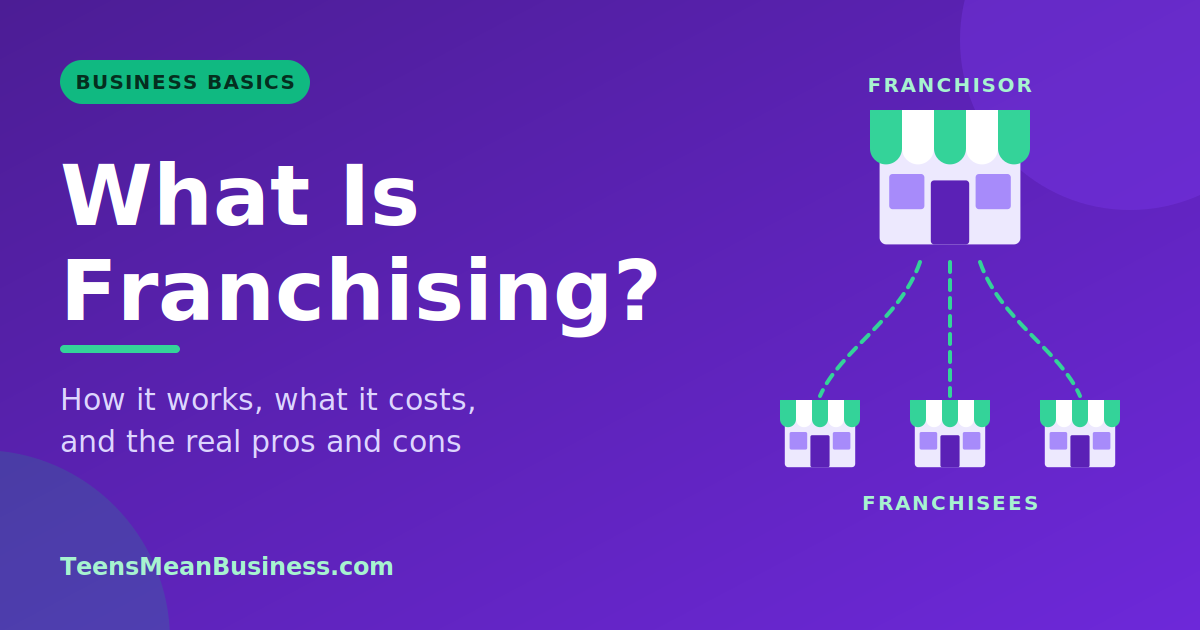
Franchising is a business model in which a company (the franchisor) lets an independent owner (the franchisee) operate a business under its brand name, using its products and systems, in exchange for an upfront fee and ongoing payments. The franchisee owns and runs the local location. The franchisor supplies the brand, the playbook, and the support.
That’s the short answer. The longer one covers how the arrangement works step by step, how both sides actually make money (with real math), the main types, what it costs, what the law requires, and how to decide whether it’s worth it.
Picture renting a proven recipe, along with the restaurant that goes with it.
A founder builds a business that works: a burger joint, a gym, a tax-prep office. Instead of opening hundreds of locations on their own dime, they license (give permission to use, for a fee and under strict conditions) their name, trademarks, and operating system to other people. Those people, the franchisees, put up the money, hire the staff, and handle the day-to-day. The brand hands over training, marketing, and an operations manual thick enough to double as a doorstop.
Two words you’ll see everywhere: the franchisor is the company that owns the brand and the system, and the franchisee is the independent owner who pays to operate under it. One distinction trips people up, so it’s worth settling now. “Franchising” is the model, the way a company grows. “A franchise” is the individual business, or the legal right to run one. You buy a franchise; a brand uses franchising to expand.
The mechanics are simpler than the paperwork makes them look.
A franchisor starts with a business that already works, because nobody can franchise a good idea, only a proven one. Next comes protecting the brand: registering trademarks and writing the operating system down in obsessive detail. Then comes the legal groundwork (in the U.S., a document called the Franchise Disclosure Document, covered further down), followed by recruiting franchisees who are both well funded and a good fit. And once they’re in, the franchisor has to train and support them. That last part is what separates a real franchise system from someone simply selling a logo.
The franchisee’s side runs in parallel. You research brands and compare costs, support, and how existing owners are faring. You read the disclosure document, then sign the franchise agreement and pay the initial fee. The franchisor typically helps with site selection and training, you open your doors, and from then on you operate by the brand’s rules.
That last phrase is where the “be your own boss” promise gets complicated. Is a franchisee really the boss if the franchisor decides the menu, the signage, and the supplier?
This is the part most definitions skip, and it explains the whole model.
A franchisee typically pays the franchisor three kinds of money: an initial franchise fee (a one-time payment for the right to join the system), royalties [an ongoing fee, usually a percentage of the location’s sales rather than its profit], and a marketing fund contribution, which pools into brand advertising.
Here’s a simple, made-up example. (The numbers are illustrative, not from any real brand.) Imagine a franchised fitness studio that brings in $600,000 in sales over a year. With a 6% royalty and a 2% marketing fee, the franchisor collects $36,000 in royalties and $12,000 for the marketing fund, $48,000 in total. The franchisee keeps the remaining $552,000, then has to cover rent, payroll, equipment, utilities, insurance, and loan payments out of it. Whatever survives is their profit.
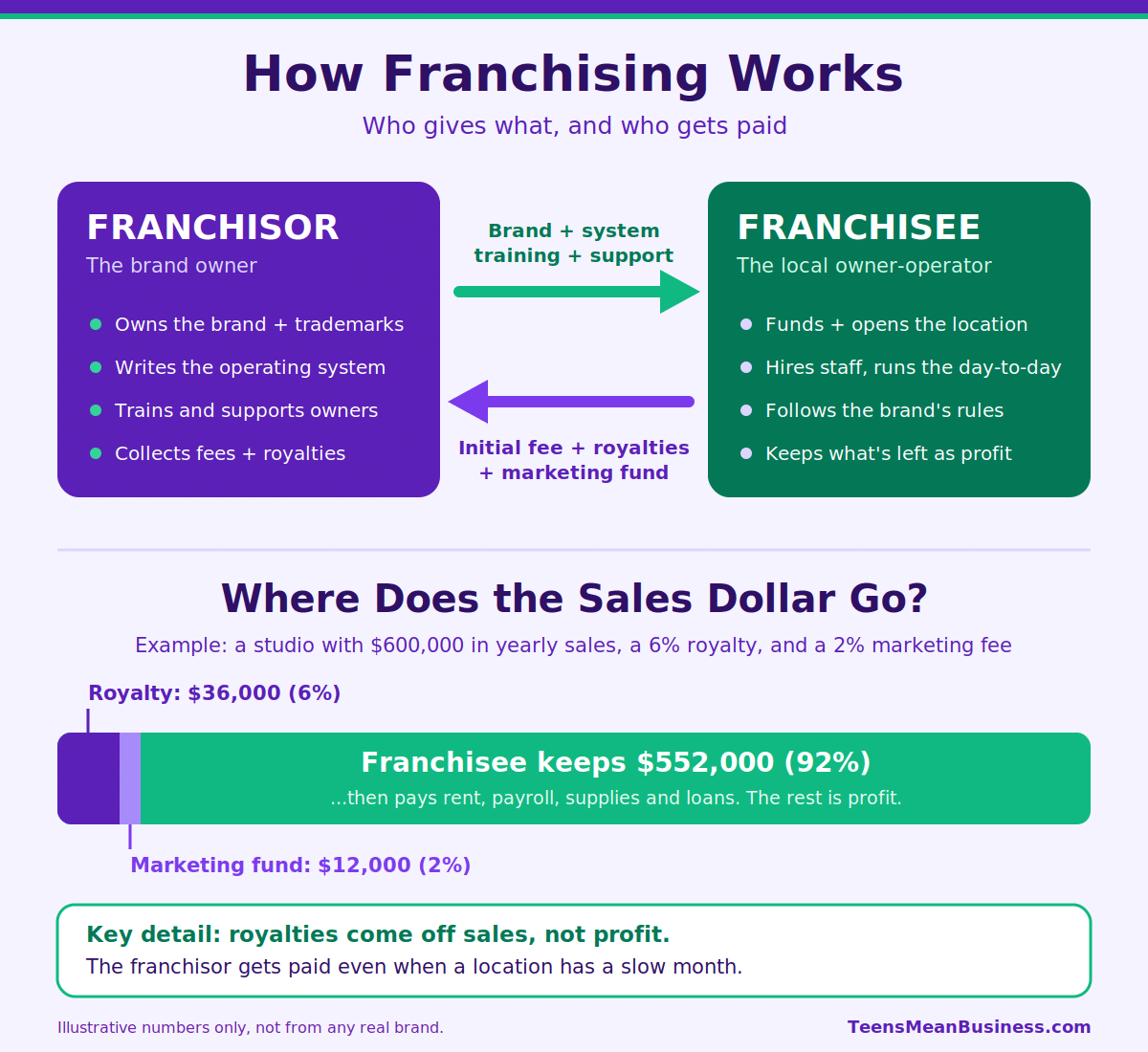
Look closely at that math, because it holds the most important detail in franchising: royalties come off the top line (sales), not the bottom line (profit). The franchisor gets paid whether or not the location makes money. That’s the reason to read the fee structure like a hawk before signing, and it’s also the franchisor’s real trade-off. Instead of keeping a location’s full profit, it takes a slice of every sale in exchange for growing without putting up the capital itself.
Not every franchise looks like a fast-food restaurant. Five models cover most of what you’ll run into.
You’ve almost certainly walked past a dozen today. McDonald’s, Subway, and Jersey Mike’s dominate fast food. Anytime Fitness and Planet Fitness cover gyms. The UPS Store handles shipping and small-business services, and many major hotel brands operate largely through franchisees. Beyond the household names, franchising stretches into home services, tutoring, senior care, and auto repair.
A quick note on a common mix-up: not every familiar chain is a classic franchise. Ace Hardware, for example, is usually described as a retailer-owned cooperative [a business owned by its member stores rather than by a single parent company]. It looks like a franchise from the parking lot, but the ownership structure is different. And the broader difference between “chain” and “franchise” is simply this: a chain is any group of similar locations sharing a brand, while a franchise is one way a chain can be owned. Some chains are company-owned, some are franchised, and many are a mix.
Honest answer: it varies wildly, and the sticker price is rarely the whole price.
The initial franchise fee commonly lands somewhere between about $20,000 and $50,000, though some brands charge as little as $10,000 and others, hotels especially, can run well past $75,000. But the fee is only the entry ticket. The total startup investment also includes equipment, inventory, signage, build-out, insurance, legal fees, a lease deposit, and working capital [the cash that keeps the doors open until the business pays for itself]. Depending on the brand, that can range from a few tens of thousands of dollars for a home-based service franchise to well over a million for a restaurant or hotel.
Ongoing fees are where people get surprised. Royalties vary by brand but commonly fall from the mid-single digits up to roughly 10% of gross sales, with marketing fund contributions on top, often 1% to 5%. Some brands add technology fees, renewal fees, and transfer fees as well.
So the number to compare brands on isn’t the headline franchise fee. It’s the total investment plus the ongoing fees. Would you judge a car by the down payment alone?
In the U.S., franchising is regulated, which is good news if you’re the buyer.
The Federal Trade Commission’s Franchise Rule requires franchisors to give prospective buyers a Franchise Disclosure Document, or FDD [a standardized legal document laying out the franchisor’s history, fees, restrictions, lawsuits, and finances]. It has 23 required sections, called “items.” The detail every buyer should memorize: the FDD must reach you at least 14 calendar days before you sign a contract or pay any money, deposits included. Many states add franchise laws of their own on top.
You don’t have to read all 23 items with equal intensity, but a few deserve your attention first. Item 3 reveals litigation, including whether the franchisor is being sued by its own franchisees. Item 7 estimates your total initial investment. Item 19 covers financial performance claims, meaning what, if anything, the brand says locations earn. Item 20 lists how many outlets have opened, closed, or changed hands, and who you can call to ask.
Franchise law is specialized and varies by state, so a franchise attorney is worth the fee before you sign. Nothing in this article is legal advice.
For the franchisee, the biggest advantage is a proven model. You aren’t testing an idea from scratch, because the brand has already worked out the menu, pricing, and processes. Customers recognize the name from day one. Training and support mean you don’t need to be an expert before you start, and franchisors can often negotiate better supplier prices than a single independent shop could. Lenders may also feel more comfortable financing an established brand, though that’s never guaranteed.
For the franchisor, the draw is speed. Franchisees fund their own locations, so a brand can scale without raising nearly as much money itself. Owners who have their own savings on the line also tend to care more than the average hired manager. And because franchisees handle local operations, the franchisor can focus on the brand and the system.
Any article that skips this part is selling something, so here are the trade-offs.
Franchisees give up independence. You follow the franchisor’s rules on products, pricing, suppliers, hours, and design. Fees never stop, either: royalties are due whether you’re thriving or struggling. Contracts can run for years and include renewal terms, territory limits, and non-compete clauses [rules limiting you from running a similar business afterward]. Your reputation is also tied to everyone else’s, so one bad franchisee or a corporate scandal can hurt your location. And a famous name won’t rescue a bad site or weak management.
Franchisors have their own headaches. Franchisees are independent owners, so quality can slip in ways a company-owned store wouldn’t allow. The franchisor earns a percentage of sales instead of a location’s full profit. Supporting, auditing, and legally managing a network takes serious infrastructure, and one franchisee’s mistake lands on the brand’s doorstep.
These get blurred together constantly, so here’s the clean version.
Franchising vs. licensing. Both involve permission to use someone’s brand or intellectual property. The difference is control and support. A simple license lets you use a name or product with relatively few strings, while a franchise comes with a full operating system, quality control, ongoing support, and ongoing fees. Under U.S. federal rules, an arrangement generally counts as a franchise when it combines a trademark license, significant control or assistance from the brand, and required payments.
Franchising vs. starting from scratch. An independent business gives you total freedom and all the profit, but you build the brand, systems, and customer base yourself, and most of the learning happens at your own expense. Franchising trades some freedom and some revenue for a head start.
Franchising vs. company-owned locations. A company that opens its own stores keeps full control and full profits but has to fund every location. Franchising shifts much of that cost onto franchisees, at the price of some control.
Before chasing any brand, it helps to be brutally honest with yourself. Do you want a proven system, or total creative freedom? Can you follow someone else’s rules even when you’d do it differently? Are you comfortable giving up a percentage of every sale for as long as the agreement runs? Do you have the cash for the total investment, plus enough to survive a slow first year? And have you talked to at least five current franchisees, away from the franchisor’s sales team?
If most of those feel like a yes, franchising may suit you. If the idea of a rulebook makes your eye twitch, an independent business may be a better fit. Either way, you’ll make a smarter choice knowing exactly what you’re signing up for.
Franchising is, at heart, a trade. The brand gives up a slice of every sale to grow faster, and the owner gives up some independence to start with a head start. Done well, both sides win. Done carelessly, one side signs a contract they never fully read.
So read the disclosure document. Talk to current owners. Do the math twice. And if you still think “franchise” means a movie with too many sequels, at least now you know which kind of sequel pays royalties.