Physical Address
304 North Cardinal St.
Dorchester Center, MA 02124
Physical Address
304 North Cardinal St.
Dorchester Center, MA 02124


I once threw a graduation party where the cake said “Congradulations.” Forty guests photographed it before I noticed. My cousin the English teacher asked, very kindly, whether it was a joke.
Nobody remembers the balloon arch. They remember whether the grad felt celebrated, whether the food ran out and who got stuck next to the uncle with strong opinions about lawn care.
So how do you pick a graduation party that works when every website is trying to sell you a banner? This guide skips the shopping list. Below are 25 graduation party ideas sorted by the kind of party you actually want to host, plus the practical stuff most guides leave out: what it costs, how far ahead to plan, how much food to buy, and how to survive three parties on the same Saturday. It works whether your grad is walking out of kindergarten, high school, a trade program or a doctoral defense.
These are the workhorses. They scale up, forgive mistakes and let guests wander in and out. Two quick notes on how to read the list. Each idea carries a rough cost cue (low, moderate or high), relative to the others rather than a price quote, since a taco bar in one town costs what a sit-down dinner does in another. And an open house [a come-and-go party with a set window, usually two to four hours, instead of one sit-down meal] is the format most families choose, because guests can drop in between the other parties on their calendar.
1. The backyard open house. The default for a reason. Pick a window (1 to 5 p.m. works), set food out in self-serve stations and park the grad near a photo table so nobody has to endure a formal receiving line. It handles a big guest list better than anything else here, and it stays on the low to moderate side of the budget.
2. The BBQ with lawn games. Burgers, hot dogs, corn on the cob. Then cornhole, ladder toss and giant Jenga, because a game gives people something to do with their hands and an excuse to talk to a stranger. Cousins and classmates end up mixing without anyone arranging it. A modest bill for a lot of afternoon.
3. The build-your-own bar. Choose one format (tacos, sliders or baked potatoes) and let guests assemble their own. Picky eaters and vegetarians sort themselves out, it scales to any headcount, and you stay out of the kitchen. Costs land in the middle of the pack.
4. The picnic in the park. No yard, or too many guests for the one you have? A park pavilion gives you space and a free playground for the little cousins. Check whether your city wants a reservation for the pavilion and a permit for amplified music before you print invitations. Low cost.
5. The pool or beach party. Swimsuits, a cooler, a playlist, done. It suits a grad who lives in the water and a crowd that mostly knows each other. One adult who isn’t drinking should be the designated water watcher [someone whose only job is to keep eyes on the swimmers], with no exceptions. Costs stay modest if the venue is free.
6. The block party. Closing the street for an afternoon turns the whole neighborhood into the guest list, which is a gift for younger grads. Ask your city what a street-closure permit takes before promising anyone a bounce house. Moderate on paper, but splitting it with neighbors brings the number down fast.
A smaller party isn’t a lesser one. With fewer guests, you can actually talk to everyone, and so can the grad.
7. The backyard dinner with toasts. One long table, a simple menu and a handful of people who know the grad well enough to say something real. Go around the table and ask each guest for a one-sentence memory or a piece of advice. Expect at least one person to cry, and plan on it being a good thing. Moderate cost.
8. The graduation brunch. Mini quiches, pastries, a fruit platter and, if you’re feeling ambitious, a waffle bar. Brunch is cheaper than dinner, wraps up before the evening plans begin and suits families with early flights home. Mid-range at most.
9. The dessert and coffee party. Who says a party needs a meal? A cake, trays of cookies or cupcakes, coffee and something cold to drink is plenty for a two-hour afternoon. The invitation just needs to say “dessert” so nobody arrives hungry. Low cost.
10. Dinner at the grad’s favorite restaurant. Let them choose the place. Call ahead about a group reservation, ask whether there’s a set menu for parties and find out whether the restaurant will split the check or take one payment. This is the easiest option on the host and often the priciest on the wallet: moderate to high.
It can, if the formality is in the details and not in the rules. Good lighting, real glassware and a toast do more than a dress code.
11. The garden party. Sparkling cider or lemonade, finger food and a lot of flowers. It suits a college or graduate celebration where relatives want a real conversation with the grad. Book a photographer for twenty minutes of portraits among the greenery and you’ll have the pictures everyone asks about later. Plan on a moderate budget.
12. The winery or vineyard party. More grown-up, and best when most guests are of legal drinking age. Many venues will provide cheese and charcuterie [a spread of cured meats and cheeses] boards on request. Arrange rides home before anyone pours the first glass. Moderate to high.
13. The formal dinner. A sit-down meal, place cards and short speeches from a parent, a mentor and, if the grad is brave, the grad. Once the guest list passes about twenty, a caterer stops being a luxury and starts being a sanity measure. This is the splurge of the list.
14. The evening cocktail party. Passed appetizers, a signature mocktail [a non-alcoholic cocktail] named after the grad and a playlist that won’t make the grandparents flinch. It fits professional and graduate programs, where most of the crowd is adult. The cost climbs with the bar.
Here’s the good news: guests remember the feeling of the day far more than the price tag. These five keep costs low without looking like it.
15. The potluck. You supply a main dish and drinks; guests bring a side or dessert. Put a sign-up request on the invitation, or you’ll end up with nine pasta salads and no napkins. Cheap, social and forgiving.
16. The joint party. If the grad’s closest friends are celebrating too, split the cost, the cleanup and the guest list. Two or three families sharing one backyard also means one fewer Saturday for the relatives to cover. The per-family cost drops sharply.
17. The ice cream sundae bar. Tubs of ice cream, bowls of toppings, root beer for floats. It’s a hit with elementary and middle school grads and with adults who’d never admit they wanted one. Low cost, and almost no cooking.
18. The movie night. A favorite film, or a slideshow of old photos mixed with short video messages from friends and family. A projector aimed at a backyard wall or a bedsheet is enough, plus popcorn and candy. Hard to overspend.
19. The “just cake” party. One good cake, a pitcher of lemonade and a clear start and end time. It’s also the right call when a big party would feel like too much for the grad’s personality. Very low cost, and honest about what it is.
A few budget habits apply to all of them. Host at home instead of renting a venue, since the venue is usually the single biggest line item. Choose one main food format instead of a sprawling menu. Send digital invitations. Borrow tables, coolers and serving trays from friends. Decorate one focal area, such as a photo display, rather than the whole house.
These six trade the standard cake-and-banner formula for something the grad will actually bring up at Thanksgiving.
20. The regional send-off. Build the menu around where the grad is headed: a crawfish boil for a school in Louisiana, a clambake for the Northeast, pizza for New York, tacos and agua fresca for the Southwest. Add a trivia round about their new city and you’ve given everyone a conversation starter. Moderate.
21. “Oh, the Places You’ll Go.” Maps, a globe centerpiece, luggage-tag name cards and a menu of dishes from different countries. It’s a natural for a gap year, a move abroad or a start nobody can predict yet. Costs stay reasonable.
22. The career-themed party. Skip the generic caps and tassels and let the grad’s field do the decorating: stethoscopes for a future nurse, blueprints for an engineer, a tool-belt dessert table for a new electrician. It’s mostly a matter of props.
23. The throwback party. Dress the room in the decade, or the exact year, the grad was born. Print a one-page “what the world looked like then” sheet for each table and let guests guess old prices. A thrift-store run covers most of it.
24. The awards ceremony. Hand out silly superlatives, such as “Most Likely to Text Back Instantly” or “Best Study Snacks,” to the grad’s friends and family. Keep the awards kind, keep the speeches short and let someone other than the host be the emcee [the person who runs the program]. It costs almost nothing.
25. The game night with a twist. Board games, card games or video games, plus a “how well do you know the grad?” quiz built from baby photos and childhood stories. Prizes can be as simple as candy. Low cost.
The party type is the skeleton. These four pieces are the clothes. You don’t need all of them, but a little of each keeps the afternoon from feeling like a generic cookout.
A theme ties the invitation, the napkins and the cake together, so every other decision gets easier. Reliable picks:
Less than Pinterest suggests. Pick one color palette and repeat it across balloons, napkins and food labels, then spend your effort where guests look first: the entrance and the photo spot.
Games matter most when two sets of friends and family have never met. One or two is plenty. Skip the rest and let people talk.
Keep prizes small, and make every game optional.
Only if they’re good and cheap. A single well-chosen take-home beats a goody bag of filler. Easy options: cookies or mini cupcakes in school colors, a small bag of candy, a seed packet or mini succulent with a “watch them grow” tag, or a photo magnet. If money is tight, skip them. Nobody leaves a good party upset about the favors.
Pick one or two of these and layer them onto whichever party you chose. More than that and it starts to look like a museum exhibit.
Why does this matter more than the decorations? Because decor gets thrown out on Monday, and a box of handwritten advice doesn’t.
Graduation weekend is busy and the people who love the grad most don’t always live nearby. A little planning lets them be part of the day instead of reading about it afterward.
A few cautions. Test the audio and Wi-Fi before guests arrive, keep the link private, and ask permission before posting any clips publicly. Mind the time zones too, because a toast at 3 p.m. for you may land at midnight for Grandma.
Planning a fully virtual party instead? Mail treats to guests, share one photo album everyone adds to, and run the trivia round over video. Ask guests to stage a tiny party at home and post a photo with a shared hashtag, and the celebration spreads out without anyone traveling.
Food that survives a few hours on a table, feeds a crowd and doesn’t chain you to the stove. That means slider and taco bars, BBQ, sandwich and wrap platters, pasta and potato salads, and grazing trays of fruit, vegetables and cheese. Mini versions of anything, from cupcakes to nachos, are easier to eat while standing and talking.
Time the menu to the clock. A brunch party wants pastries and fruit. A 4 p.m. open house wants something heartier than chips. A dessert party can skip dinner entirely, as long as the invitation says so.
A few rules of thumb worth keeping on a sticky note:
One more honest note. A single cake is lovely, but a cupcake tower or a cookie table is far easier to serve to forty people than a sheet cake and a knife.
It depends almost entirely on the venue and the food. A backyard open house at home commonly runs a few hundred dollars, while a catered party or rented venue can climb well past a thousand. Your own number will vary by city and guest count, so set a ceiling before you buy anything and divide it by your headcount. That per-guest figure is the one that keeps the small extras from quietly adding up.
Here’s where the money tends to go, and where it tends to leak:
| Line item | Where costs creep | Easy way to trim |
|---|---|---|
| Venue | Rental fees, cleaning deposits, tables and chairs | Host at home or in a free park pavilion |
| Food | Full catering for an open house | One food format, plus a few make-ahead sides |
| Cake and desserts | A custom sheet cake nobody finishes | Cupcake tower or a simple cake plus cookies |
| Drinks | Specialty cocktails and bottled everything | A lemonade and iced tea dispenser, plus water |
| Decor | Matching everything in school colors | One strong focal area, like a photo wall |
| Favors | Goody bags full of filler | One small take-home, or skip it |
| Entertainment | Photo booth rentals, DJs | A playlist and a few lawn games |
One trade-off worth naming: the cheapest option isn’t always the least stressful. A caterer for a big party can be money well spent if it keeps you from spending the whole afternoon behind a chafing dish.
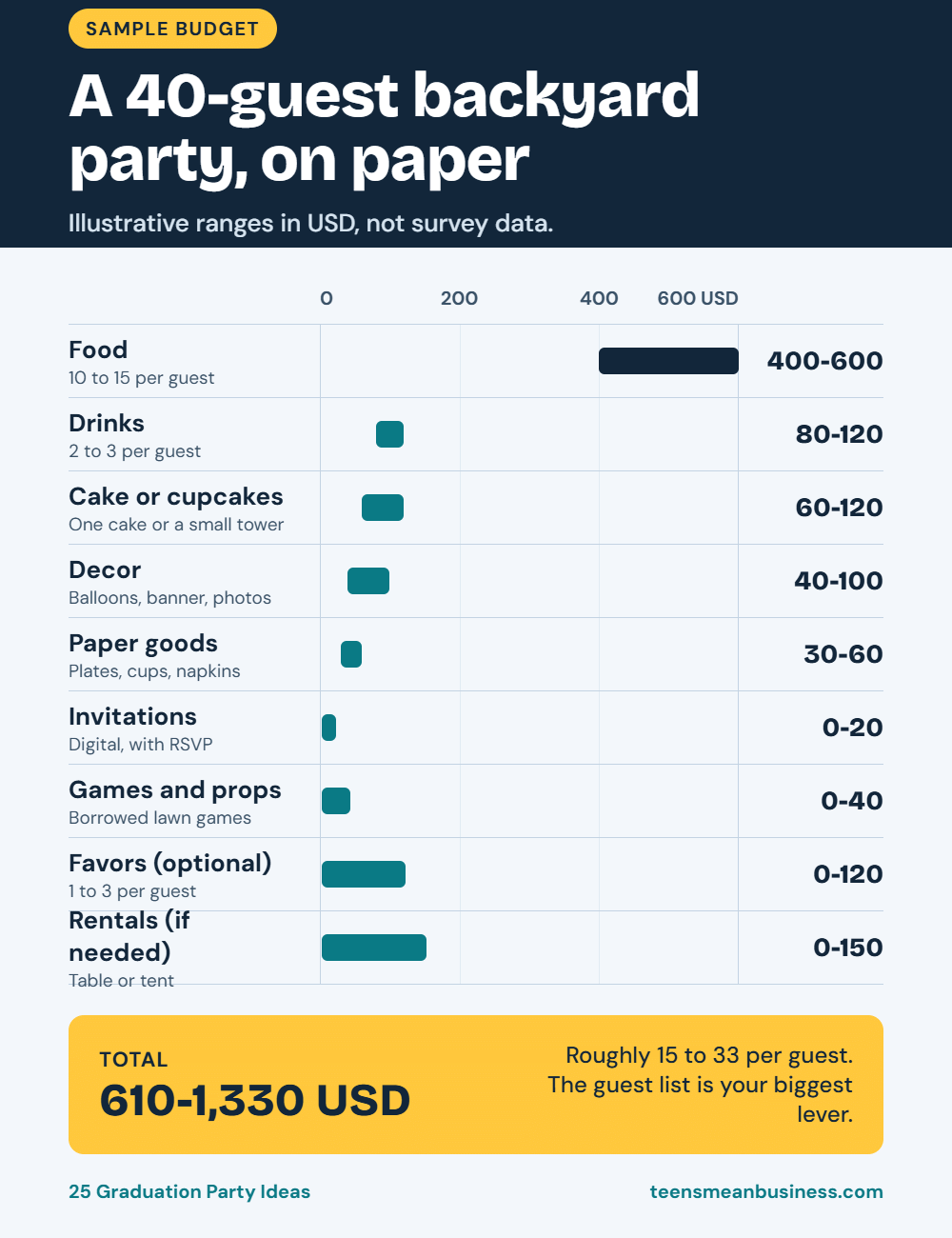
Here’s an illustrative budget for a self-catered open house at home. Treat the figures as planning ranges, not survey data, and swap in your own local quotes before you commit.
| Item | What it assumes | Estimated cost (USD) |
|---|---|---|
| Food | A build-your-own taco or slider bar with two sides, about 10 to 15 per guest | 400–600 |
| Drinks | Lemonade, iced tea, soda and plenty of water, about 2 to 3 per guest | 80–120 |
| Cake or cupcakes | One simple cake or a small cupcake tower | 60–120 |
| Decor | Balloons, a banner and printed photos for a timeline | 40–100 |
| Paper goods | Plates, napkins, cups and cutlery | 30–60 |
| Invitations | Digital, with RSVP | 0–20 |
| Games and props | Borrowed lawn games and a few photo props | 0–40 |
| Favors (optional) | One small take-home, about 1 to 3 per guest | 0–120 |
| Rentals (if needed) | A table or tent for shade or rain | 0–150 |
| Total | about 610–1,330 |
That works out to roughly 15 to 33 dollars per guest, and the guest list is the biggest lever you control, since food and drinks scale with every extra head. For context, one 2026 cost guide puts a high school party for 25 to 50 guests at roughly 400 to 900 dollars, and a college party at 800 to 2,000 dollars.
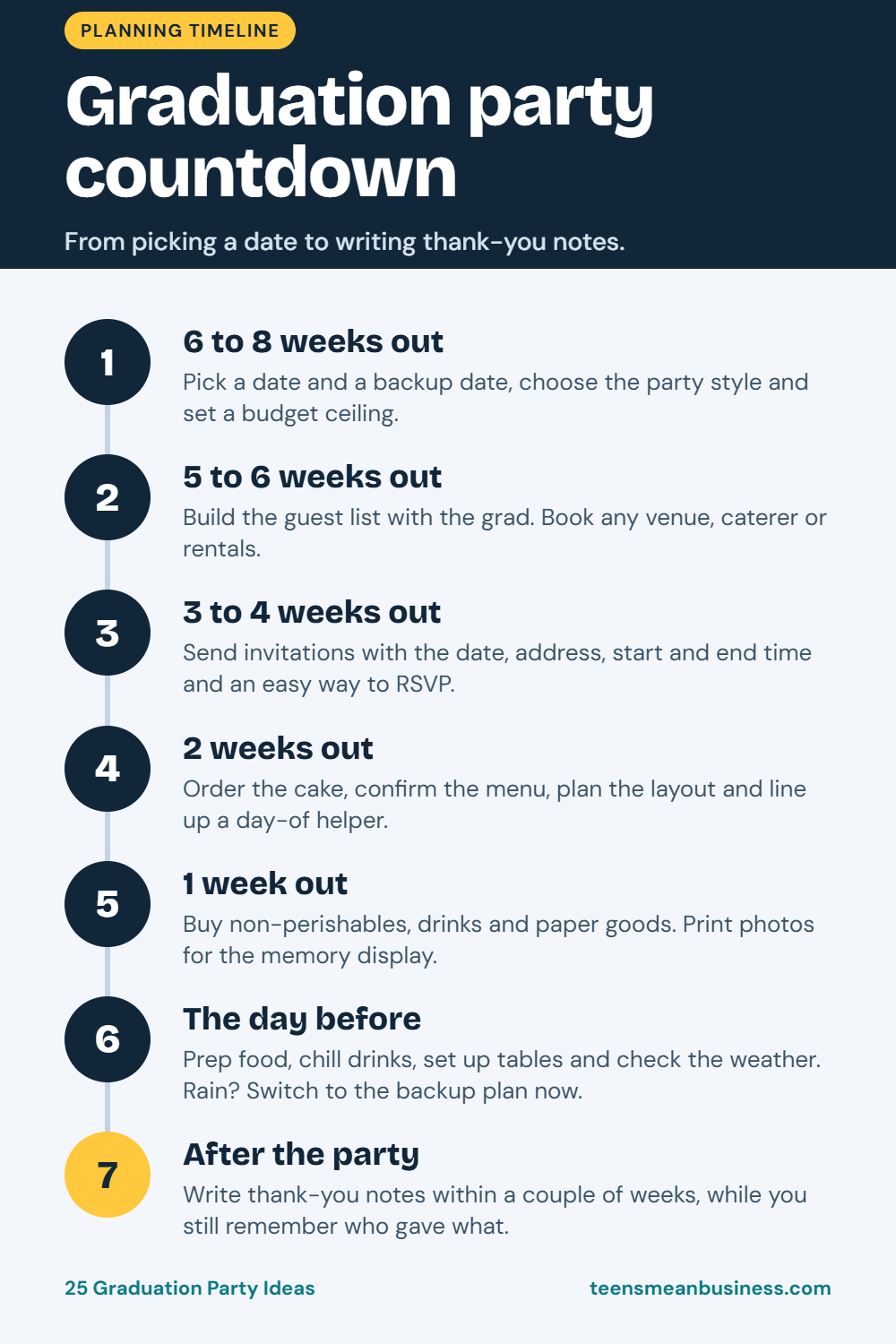
Start four to eight weeks out. That’s enough time to lock in a date and place without living on a checklist for a month. Add a few extra weeks if you’re booking a venue, a caterer or a rental company in May or June, when everyone else is booking them too.
Every graduation party comes with the same handful of social puzzles. Better to solve them in advance than at the buffet table.
What if your guests are also going to three other parties that day? They are. Graduation weekends are crowded, so an open house with a generous window gives people room to pop in, eat and move on without feeling rude. Coordinate with the grad’s close friends when you pick a date, so you’re not competing for the same afternoon.
Who gets invited? Build the list with the grad, not for them. Start with close family and the grad’s own friends, then add neighbors, family friends and extended relatives as space and budget allow. Set a firm number before you start and stick to it.
What about gifts and cards? Set out a decorated box or basket for cards, and assign one trusted person to watch it. Cash and gift cards can easily go missing in a crowded house. If you’d rather not receive gifts, say so plainly on the invitation.
Who gives the toast? Ask two or three people ahead of time and give each a two-minute limit. Nothing sinks a party faster than an open mic with no end.
What if there’s an alcohol question? In a mixed-age crowd, set up a clear mocktail station so nobody feels left out, and plan rides home if you’re serving alcohol to adults.
What if it rains, or it’s 95 degrees? Have a backup plan: a tent, a garage, a shaded spot, or an indoor area. Rental companies book fast in graduation season.
Most guides assume a teenager in a cap and gown. But graduation covers a lot more ground, and the party should match the milestone.
Pick the party that fits the grad and the budget, not the one that photographs best. Choose one personal touch. Send the invitations three or four weeks ahead. Then let go of the rest.
As for my own party, the one with the misspelled cake? The grad still brings it up every year. The icing was wrong, but the people were right, and that’s the part that lasted.