Physical Address
304 North Cardinal St.
Dorchester Center, MA 02124
Physical Address
304 North Cardinal St.
Dorchester Center, MA 02124

My first business lasted nine days.
I was fifteen. I’d spent my birthday money on a set of calligraphy pens, and the plan was to sell hand-lettered name cards to the entire school. I had a logo. I had a price list. What I didn’t have was a single customer, because it never occurred to me to ask anyone whether they wanted a hand-lettered name card. (They didn’t. My family still has a drawer full of them.)
That mistake is why this guide puts “check that people will pay” well before “design a logo.”
The short version: to start a business as a teenager, you
There’s no minimum age, and you don’t need a big budget. The best first businesses cost very little to start.
The rest of this guide walks through each step, including the parts most guides skip: what to actually say to your parents, which platforms won’t let you sign up on your own, and what the IRS expects once your profit hits $400. There’s also a free one-page planning sheet to download in Step 3. One note before we start: the legal and tax details here are for the United States. The steps work anywhere, but the rules on contracts, permits and taxes change from country to country.
Yes. There’s no federal minimum age for running a small business, and teenagers are doing it right now: mowing lawns, tutoring, designing logos, selling stickers out of their bedrooms.
The catch is contracts. In most states you’re a legal minor until 18, the age of majority [the age at which the law treats you as an adult who can sign binding contracts]. A contract signed by a minor can generally be cancelled later by the minor — lawyers call that “voidable” [valid, but the minor can walk away from it] — which is exactly why banks and payment companies get nervous about dealing with you directly. So an adult usually has to handle certain pieces of paperwork: opening a bank account, forming a company, signing up for some online tools.
Is that a dealbreaker? Not even close. It’s the only real wall. Ideas, customers, pricing and hustle are all open to you.
With a thousand ideas floating around, where do you even start? Not by hunting for “the best business idea for teens.” Nobody can hand you one, and most lists are the same twenty ideas in a different font. Run any idea through three questions instead. Can you already do it, or learn it in a weekend? A business built on a skill you have starts faster and survives the boring middle stretch. Do people already pay for something like it? Demand you can see, neighbors paying for yard work, parents paying tutors – beats demand you’re only hoping for. And can you start it cheaply and run it around school? Aim for something that costs little upfront and fits into a few hours a week.
Still stuck? Match your strengths to a starting point:
Notice how many of those are services? That’s not an accident. Services are usually the easiest place to begin, because your time is the main cost and you don’t have to buy inventory. Products take more work upfront, cost money for materials, and run straight into those platform age rules.
Boring can win, too – if you add a twist. Fraser Doherty started SuperJam at 14 using his grandmother’s recipes, selling first to neighbors and friends from his church before working his way into supermarkets. Jam isn’t a new idea. His twist was making it entirely from fruit. A familiar product, one clear difference, and a first sale to the people around him. That’s the whole recipe.
Want a bigger menu of ideas? Browse our guides to how to make money as a teenager and teen side hustles, then come back here for the launch process.
Testing your idea before you invest is called validation. It’s the step I skipped with the name cards, and it’s the cheapest one in this whole guide.
Ask ten people who could plausibly become customers: neighbors, parents of classmates, the owner of a local shop. Skip your best friends and relatives for this round. They’ll say “that’s so cool!” about anything. Ask a specific question with a specific price attached, like this:
“Hi Mrs. Alvarez, I’m starting a dog-walking service in the neighborhood: 30-minute walks for $10, weekday afternoons. My first five customers get their first walk half off. Interested?”
Then comes the real test: get three people to actually pay, even at a launch discount. “Sounds great” is a compliment. A payment is a customer. If you can’t find three, you’ve learned something for free, and you can change the price, the audience or the whole idea without a drawer full of unsold name cards.
Even where the law doesn’t require it, you’ll want them in your corner. They’ll be the ones signing forms, holding accounts and, let’s be honest, driving you places. The conversation goes better if you walk in with a plan rather than a plea.
Parents tend to worry about four things: grades, safety, money and liability [being legally responsible if something goes wrong]. Bring a one-page plan that answers all four:
Add a few safety ground rules while you’re at it: meet customers in public or with an adult nearby, keep your home address and phone number off listings, and let a parent see your business accounts and messages. Offering these before anyone asks is one of the fastest ways to earn a yes.
Don’t want to build the page from scratch? We made one. The Teen Business Launch Plan is a free, one-page sheet with a spot for everything above, plus a place for you and a parent to sign. Fill it in on your screen or print it out. DOWNLOAD LINK
Short answer: you’ll probably want a bank account, you might need a license, and you can probably skip the LLC for now. (This is general information, not legal advice, and the rules vary by state and city.)
Start with structure. Most teens begin as sole proprietors [businesses that aren’t legally separate from their owner, so you and the business are one and the same], which in most states means no registration and no filing fee. The trade-off is that there’s no legal wall between you and the business, so if something goes wrong, you’re personally on the hook. An LLC adds protection, but minors generally can’t sign the formation paperwork themselves. A parent or guardian typically files on your behalf, and some states add extra rules for minors, so check your state’s Secretary of State website before you spend a cent. For a first business with small stakes, most teens can start as a sole proprietor and revisit the question if the business grows or the risk goes up, for example if you’re selling products that could hurt someone or taking on bigger clients.
What about the name? If you operate under something other than your own legal name, your state or county may want you to register a DBA [“doing business as” name]. Your county clerk or state website will tell you.
Licenses and permits depend on what you sell and where you live. Your city or county may require a business license, your HOA may have opinions about customers showing up at your house, and if you sell food, those cottage food laws from Step 1 apply. Selling physical products? Your state may also expect you to collect sales tax, so check that too.
Then there’s the money itself. Keep business money separate from personal money from day one. Most banks require a parent or guardian to co-own an account for anyone under 18, so ask about youth or custodial accounts [accounts an adult manages on a minor’s behalf].
The place teens trip up most is the age rules on selling and payment platforms, so check them before you build anything on one. Terms change, but as of this writing Etsy lets teens 13 to 17 sell only through an account owned by a parent or guardian, with all financial information in the parent’s name. Etsy’s rules for minors spell it out. Shopify and PayPal both require account holders to be 18, so a parent will likely need to be the one who signs up. And don’t fake your age: accounts opened with a false birthdate can be shut down, and the shop you spent months building goes with it.
Or skip platforms at the start. Cash, in-person sales and local customers work fine for a first business.
The classic beginner move is pricing by feel (“$3 seems fair?”). Use a formula instead:
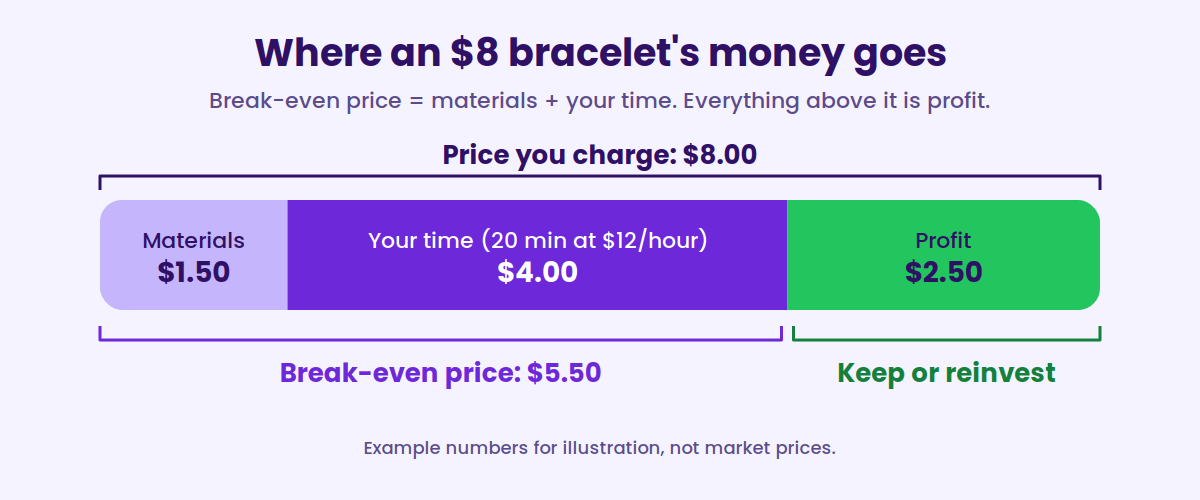
Price = cost of materials + your time × the hourly rate you want + any fees. Anything you charge above that is your profit margin [the slice of each sale you keep after all costs].
Say you make friendship bracelets. Materials cost $1.50 per bracelet, each takes 20 minutes, and you want to earn $12 an hour. Your time is worth $4 per bracelet, so your break-even price is $5.50. Charge $8 and you clear $2.50 on top of paying yourself, money the business can use to buy more materials or grow.
For a service, start with the hourly rate you want, then check what local competitors charge and price close to them. Going far under looks like a discount, and it feels like a chore by week three.
Keep a simple spreadsheet from day one with five columns: date, customer, money in, money out, hours worked. It takes two minutes a week and it answers nearly every question you’ll have about whether the business is working.
Start close to home and work outward in three circles.
Then do two things after every good job. Ask for a referral, and ask for one sentence you can quote as a testimonial. Word of mouth is the cheapest marketing there is, and it works best when your first five customers feel like your only customers.
By building the guardrails before you need them. Set a weekly time cap you can actually keep four to six hours is a sensible start and schedule it in blocks that don’t move around, Saturday morning, say. Keep the grades-first rule you promised your parents in Step 3, because it protects you from yourself as much as it reassures them. Spend fifteen minutes a week on a review: money in, money out, hours worked, and one thing to change. And keep business money in its own place, since the moment it mixes with your spending money you lose track of what you’re really earning.
Now for the part most teen guides get vague about: taxes. Yes, teenagers can owe taxes on business income. The rule to know is this: if your net earnings from self-employment [your business income minus your business expenses] reach $400, you generally owe self-employment tax [the Social Security and Medicare taxes that self-employed people pay themselves, because no employer withholds them] and have to file a tax return. The IRS explains the rule on its self-employment tax page. The rate is 15.3% applied to 92.35% of your net earnings, which works out to a little over 14% of your profit.
Regular income tax is a separate calculation. It depends on your total income and whether someone claims you as a dependent, so sit down with a parent or a tax professional to look at your situation. In the meantime, set aside about 15% of your profit in a separate spot and keep every receipt.
The steps stay the same. What changes is who does what.
Around 13 or 14, you’re old enough for Etsy (through a parent-owned account) and most social platforms, but an adult will handle nearly everything formal. Stick to local, low-cost services like pet care, yard work or tutoring younger kids, where cash or a parent-run payment account does the job, and keep the hours short. This is the age to learn how pricing and customers work, not to build an empire.
Around 15 or 16, you can run the day-to-day yourself: talking to customers, scheduling, marketing, bookkeeping. There’s more room for skill-based and online work such as design, editing, social media or reselling, and for bigger customers like local businesses. Those customers may want an adult to sign anything formal, so keep a parent in the loop. It’s also when school, sports and your social life compete hardest for your time, which makes the time cap from Step 7 matter most.
Around 17, the finish line is in sight. Many of the walls in this guide (bank accounts, LLCs, Shopify, PayPal) are built around 18, so use your last year to build a track record: keep clean records of income, expenses, customers and testimonials. When you turn 18, ask about moving accounts into your own name and whether an LLC makes sense. A few states set the age of majority higher than 18, so check yours.
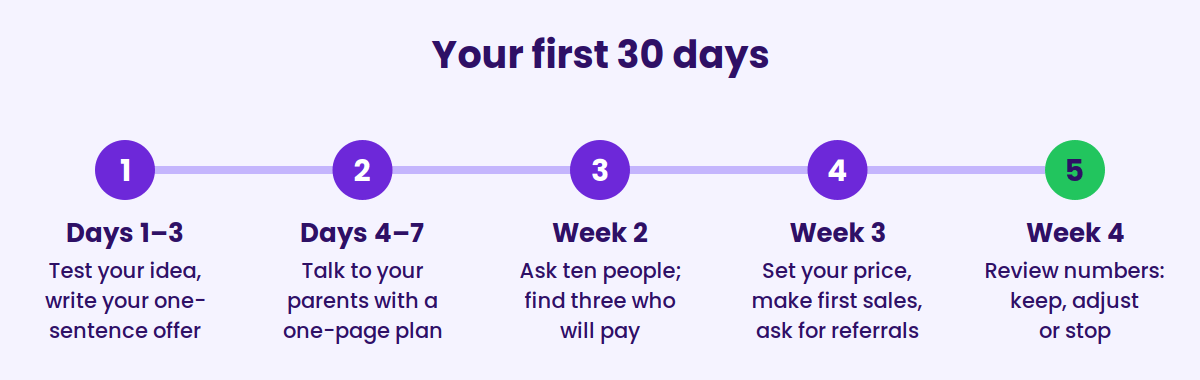
Days 1 to 3: run your idea through the three questions from Step 1, then write your offer in one sentence: “I [do what] for [whom] for [price].” Days 4 to 7: have the parent conversation, one-page plan in hand. Week 2: ask ten potential customers, and aim for three who will actually pay. Week 3: set your price, deliver your first jobs or sales, take photos and ask for referrals. Week 4: look at your numbers. Keep going, adjust the price, audience or offer, or stop. All three are legitimate outcomes.
How old do you have to be to start a business? There’s no federal minimum age. In practice, you can start at almost any age with a parent’s help, though platforms set their own limits: Etsy allows 13 to 17 through a parent-owned account, while Shopify and PayPal require 18.
What’s the best business to start as a teenager with no money? A service business, like tutoring, pet care, yard work or tech help. Your time is the main cost, so there’s almost nothing to buy upfront.
Can I start a business at 14, 15 or 16? Yes. The steps are the same at any teen age. The younger you are, the more an adult will need to handle the paperwork, accounts and payments.
Can I start a business without my parents? You can start doing the work on your own, but banks, payment platforms and most formal setup steps need an adult. It’s also smarter to have one in your corner from day one.
Do I have to pay taxes on my business as a teen? If your net earnings from self-employment reach $400, you generally owe self-employment tax and have to file a return. Income tax depends on your overall situation, so review it with a parent or tax professional.
Nine days was what it cost me to learn that customers come before logos. You can learn it in an afternoon: pick an idea, write the one-sentence offer, and ask ten people whether they’d pay for it this week.
Once the first payments start coming in, our guides to how to make money as a teenager and investment tips for teens cover what to do with the profit.