Physical Address
304 North Cardinal St.
Dorchester Center, MA 02124
Physical Address
304 North Cardinal St.
Dorchester Center, MA 02124

The first website I ever launched for a business crashed on the one afternoon it actually mattered.
I’d signed up for the cheapest shared hosting [a setup where your website splits one server’s resources with hundreds of other websites, the way roommates split rent and a single Wi-Fi router] plan I could find, lured in by a banner ad promising 90% off. The site held up fine for months – right up until a much bigger blog linked to one of my posts, sent a wave of visitors my way, and my brand-new, bargain-bin server folded like a lawn chair. “Error establishing a database connection.” I spent two hours on hold, message after message, listening to hold music I will hear in my nightmares, while the one day I actually had an audience quietly slipped away.
Was I underprepared? Cheap? A little of both? Probably. But I’m not alone, most small business owners pick a host the same way I did: whichever one has the loudest discount banner. And most of the time, it works out fine, because most days don’t send you a traffic spike. It’s the one day it does that you find out what you actually paid for.
So if you’re shopping for web hosting for your small business right now, here’s what six months of watching my own hosting bill balloon and a lot of digging through fine print since – actually taught me.
If you’re in a hurry, here’s the short version. Each of these is genuinely good at one specific job, none of them is “best” at everything, and that’s kind of the point.
| Host | Best for | Starting price | Renews at | Money-back window |
|---|---|---|---|---|
| Hostinger | Best overall value | $2.99/mo | $10.99/mo | 30 days |
| Bluehost | Easiest first WordPress site | $3.99/mo | $9.99/mo | 30 days |
| SiteGround | Speed and support, if you can pay for it | $3.99/mo | $17.99/mo | 30 days |
| DreamHost | Not getting trapped by a bad renewal | ~$2.89/mo | $10.99/mo | 97 days |
| Squarespace | Zero technical setup | $16/mo (annual) | Same, no renewal shock | 14-day trial |
| Cloudways | Scaling without migrating later | ~$14/mo | Usage-based, no renewal jump | 3-day trial |
| Namecheap | Bundling hosting with a domain you already own | $2.28/mo | $5.88–$11.88/mo (monthly billing) | 30-day free trial |
Every single one of these prices comes with an asterisk, which is exactly why the rest of this post exists. Before you click “buy” on whichever one has the biggest discount badge, it’s worth understanding what you’re actually comparing.
Here’s the thing nobody tells you when you’re starting out: almost every hosting company’s marketing page looks identical. Unlimited this, unmetered that, 24/7 support, free SSL [a certificate that encrypts the connection between your site and your visitors – the padlock icon and the “https” in your browser bar]. So what should you actually be comparing?
Uptime : the percentage of time your site is actually reachable instead of showing an error. Most reputable hosts advertise 99.9% uptime, which sounds nearly identical across the board until you do the math: 99.9% still allows for over 8 hours of downtime a year, while 99.99% cuts that down to under an hour. For most small business sites, either is fine. For anything selling directly through the site, that difference is real money.
Storage type, not just storage amount. NVMe storage [a newer, significantly faster type of solid-state drive than the older SSD standard] loads pages noticeably quicker than standard SSD, which matters both for visitors who bounce off slow pages and for Google, which factors page speed into search rankings.
A CDN [content delivery network: copies of your site cached on servers around the world, so a visitor in another country isn’t waiting on a single server on the other side of the planet]. If you expect any traffic outside your home region, this matters more than most other specs on the page.
The gap between the price you see and the price you’ll actually pay. This one’s big enough that it gets its own section below.
And one thing that’s easy to overlook entirely: what kind of hosting you actually need. A shared plan, a managed WordPress plan, a cloud plan, and an all-in-one website builder are not different tiers of the same thing – they’re different products for different situations, which is why the “best” host really does depend on what you’re building.
If price-to-features ratio is the whole game, Hostinger is hard to beat right now. Its entry-level Premium plan runs $2.99/month on a long-term commitment, covering three websites and 20GB of SSD storage, and renews at $10.99/month, one of the smaller jumps in the industry. Step up to the Business tier at $3.79/month (renewing at $16.99/month) and you get unlimited websites, 50GB of NVMe storage, and a built-in CDN.
The trade-off is that the cheapest pricing requires a long commitment (up to 48 months), and Hostinger has fewer global data center locations than some bigger competitors, which can matter if your customers are spread internationally. For a small business site with modest, mostly-local traffic, that trade-off is easy to live with.
Bluehost is one of the few hosts officially recommended by WordPress.org itself, and its Starter plan starts at $3.99/month, renewing at $9.99/month, with 10 websites and 10GB of NVMe storage built in. If you’ve never set up a website before and WordPress is your plan, this is the safest, most well-documented on-ramp – there’s a reason it shows up on nearly every “best host” list on page one of Google, ours included.
The step-up Business plan, at $6.99/month renewing at $13.99/month, adds malware scanning, domain privacy, and support for roughly 200,000 monthly visits. It’s not the cheapest option on this list, and renewal pricing on the entry tier can still surprise people who don’t read the fine print but the sheer volume of tutorials, plugins tested specifically against it, and beginner-focused support makes it a genuinely low-stress starting point.
SiteGround is the host you pick when you’ve been burned by slow support elsewhere and are willing to pay to never deal with that again. Its entry StartUp plan starts at $3.99/month but renews at a steep $17.99/month, the biggest introductory-to-renewal jump of any host on this list. The GrowBig plan ($6.69/month, renewing at $29.99/month) unlocks unlimited websites and roughly 100,000 monthly visits’ worth of resources.
SiteGround consistently earns praise for speed and for actually picking up the phone. If you’ve ever lost a Saturday to a hosting support queue, that’s worth something real. Just budget for the renewal, not the flashy first-year number.
DreamHost’s Shared Starter plan runs about $2.89/month for one website, renewing at $10.99/month – competitive, if unremarkable, next to Hostinger or Bluehost. What sets DreamHost apart isn’t the price, though. It’s the 97-day money-back guarantee, more than triple the industry-standard 30 days, and one of the more transparent renewal structures in a category not known for transparency. The Web Hosting Growth plan (around $3.99/month, renewing at $12.99/month) removes the one-website cap entirely.
DreamHost also runs on its own custom control panel rather than the more common cPanel, which is either a non-issue or a minor learning curve depending on whether you’ve used cPanel elsewhere before. For a small business owner who wants real breathing room to test a host before committing, that 97-day window does a lot of the reassurance that flashy discount banners are trying – less convincingly – to do elsewhere.
Here’s an honest admission: if you have zero interest in ever hearing the words “control panel” or “NVMe storage” again after reading this article, you may not want a traditional web host at all. Squarespace bundles hosting, design, and a drag-and-drop builder into one flat subscription – no separate hosting purchase, no server settings, no renewal-price surprise. Plans run from $16/month (Basic) up to $99/month (Advanced) when billed annually, with the $23/month Core plan covering most small businesses that want to sell a modest number of products online.
The catch is flexibility: you’re building inside Squarespace’s templates and ecosystem rather than on an open platform like WordPress, so if you ever want granular control over code, plugins, or server configuration, you’ll eventually outgrow it. For a service business, boutique brand, or anyone who values “looks polished immediately” over “infinitely customizable,” that trade-off is often the right one.
Cloudways doesn’t sell fixed plans the way the others on this list do – it’s a managed layer on top of cloud infrastructure from DigitalOcean, AWS, Google Cloud, and others. Pricing starts around $14/month for a DigitalOcean-based server (1GB RAM, 25GB storage) and scales up smoothly as your traffic or store grows, without the abrupt “your renewal just tripled” moment that defines traditional shared hosting.
This is overkill for a five-page brochure site. It’s a strong pick if you’re running WooCommerce, expect real growth, or are tired of migrating to a bigger plan every time traffic spikes. The trade-off is a slightly steeper learning curve than a simple shared-hosting dashboard, worth it if scaling without disruption matters more to you than absolute simplicity.
If you already bought your domain through Namecheap – plenty of small business owners have, since it’s one of the most popular registrars. Its shared hosting is worth a look mainly for the convenience of one login instead of two. The entry-level Stellar plan starts at $2.28/month on a discounted annual term, with a 30-day free trial before you’re billed at all, covering 3 websites and 20GB of SSD storage. Stellar Plus ($2.98/month intro) drops the site limit entirely, and Stellar Business ($4.98/month intro) adds Cloud Storage and free malware protection.
Here’s the part worth flagging directly: Namecheap’s own documentation confirms it raised shared-hosting renewal prices in 2026, and its promotional discounts explicitly don’t apply to renewals. Its plain monthly-billing rate – $5.88 to $11.88/month depending on tier is a far more honest number to budget against than the trial price.
For a small business that just wants one dashboard for domain, email, and a basic brochure site, that’s a fair trade. For anything that leans harder on WordPress plugins or needs guaranteed support response times, Bluehost or SiteGround are still the stronger bet.
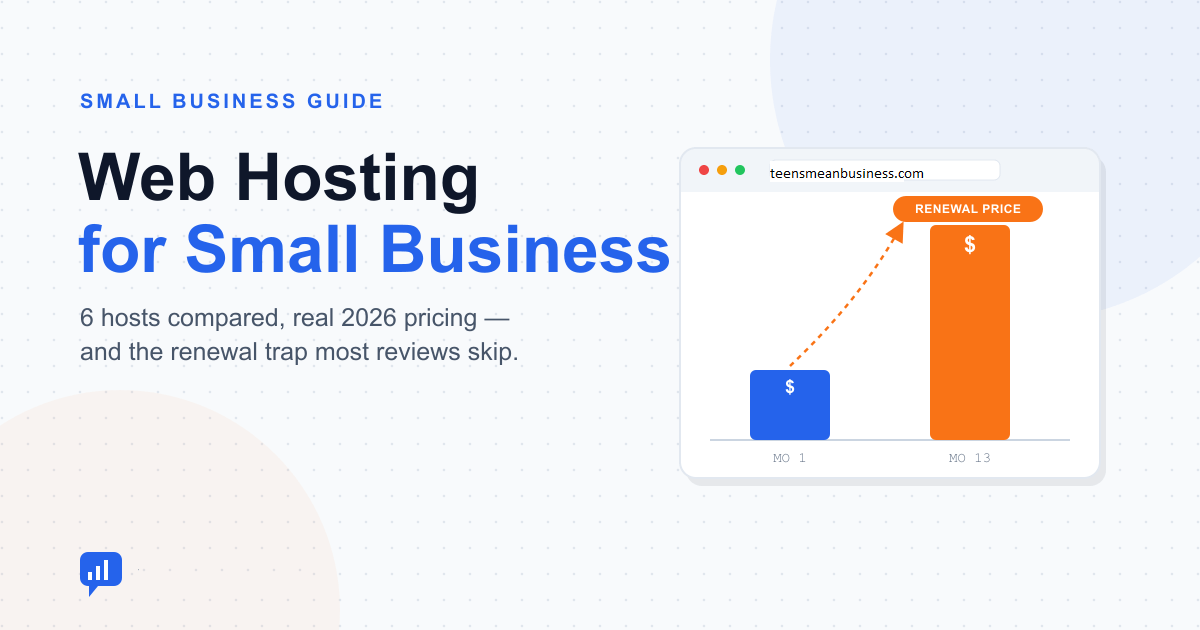
This is the part every glossy “best hosting” roundup glosses over, and it’s the single most important thing to understand before you buy: almost every price you see advertised is an introductory rate, usually tied to committing to a long contract – 12, 24, even 48 months – paid upfront. When that term ends, the plan renews at a price that can be anywhere from 50% to over 300% higher than what you originally paid.
It’s not a scam, exactly. It’s standard industry practice, and every host on this list does some version of it. But it does mean the flashy “$1.99/month!” banner you’ll see everywhere is rarely the number that matters. What matters is: what does it renew at, and how long is that promotional period actually locking you in for?
My advice, learned the expensive way: when you’re comparing hosts, put the renewal price side by side with the intro price before you decide anything. The gap tells you more about whether a host is being straightforward with you than the shiny number ever will.
None of these is objectively “best.” The honest question isn’t “which host is #1” – it’s “which category matches what I’m actually building,” and only then, which host in that category treats its renewal pricing the most fairly.
If I were starting my very first small business site again, knowing what I know now, I’d pick based on one honest question: how much do I want to think about hosting after I hit “buy”?
If the answer is “as little as humanly possible,” Squarespace earns its higher price tag. If you want the cheapest reliable option and don’t mind a little setup, Hostinger or Bluehost will treat you well. If you’ve been burned by bad support before, SiteGround’s higher renewal price buys real peace of mind. If you’re not ready to commit to anyone yet, DreamHost’s 97-day guarantee gives you the longest runway to change your mind. And if you’re already picturing the day your site outgrows its first host, Cloudways saves you that migration headache later. And if your domain’s already sitting in a Namecheap account, its hosting is a reasonable way to avoid juggling two logins – just budget for the real monthly rate, not the trial price.
Whatever you pick, do the one thing that would’ve saved me that Saturday afternoon of hold music: check the renewal price before you check out, not after.