Physical Address
304 North Cardinal St.
Dorchester Center, MA 02124
Physical Address
304 North Cardinal St.
Dorchester Center, MA 02124

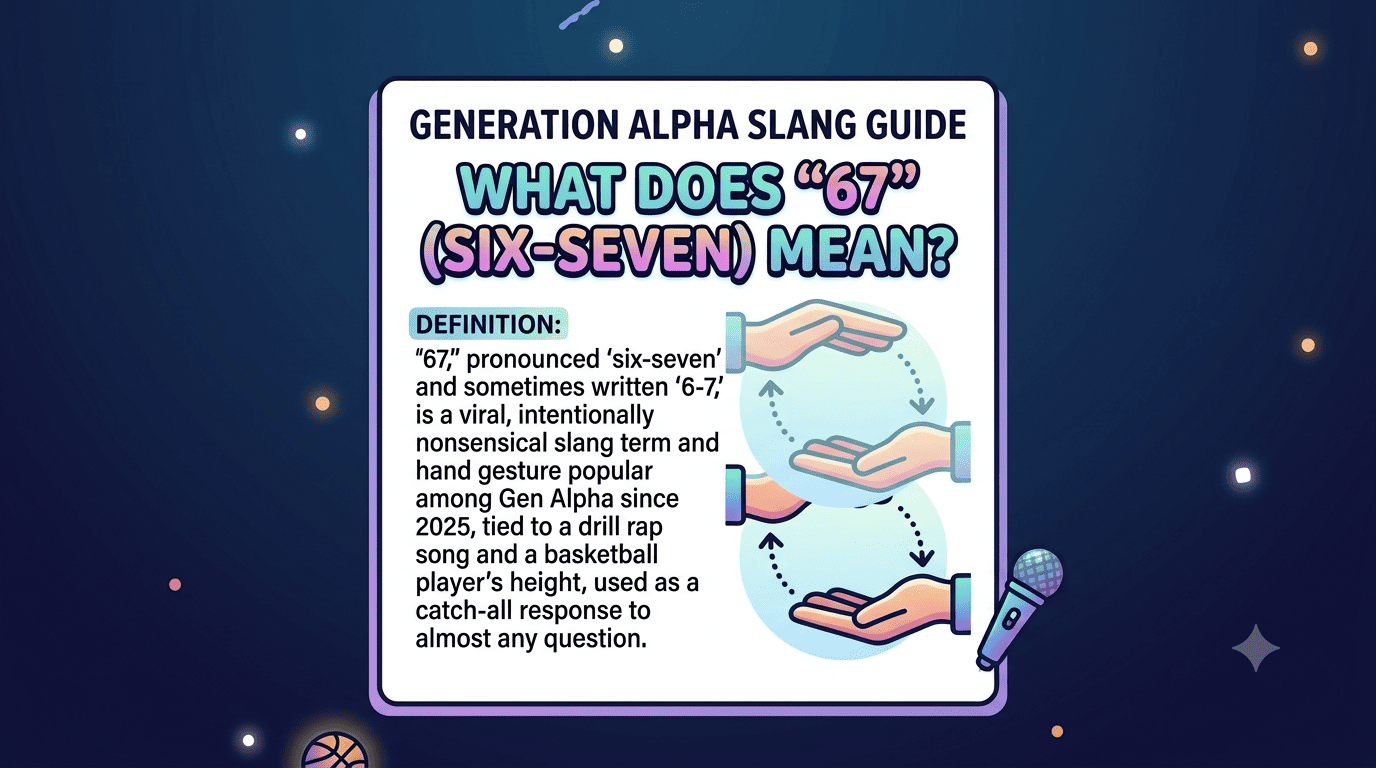
Somewhere between “no cap” and whatever comes next, I found myself standing in a kitchen listening to a group of twelve-year-olds respond to “how was practice?” with a flat, deadpan “six seven” — accompanied by a hand gesture that looked like they were weighing two invisible melons. Nobody explained it. Nobody could explain it. That, it turns out, is the entire point.
So what does 67 actually mean? Short answer: it doesn’t, really — and that’s exactly why it’s everywhere.
“67,” pronounced “six-seven” and sometimes written “6-7,” is a viral, intentionally nonsensical slang term and hand gesture popular among Gen Alpha since 2025, tied to a drill rap song and a basketball player’s height, used as a catch-all response to almost any question. It’s not meant to have a fixed meaning — using it correctly is more about the timing and the gesture than the words themselves.
Before the words, there’s the gesture — and honestly, it’s doing more communicative work than “six-seven” itself. Both palms face up at roughly chest height, then move alternately up and down, like a manual scale weighing two options against each other. It’s the same motion you’d use to say “eh, six of one, half a dozen of the other” — which lines up with the most common interpretation: “so-so,” or “could go either way.”
Said without the gesture, “six seven” is just two numbers. Said with it, it’s a complete sentence that somehow answers “how tall are you,” “how was your day,” and “what’s the answer to this math problem” equally well.
There isn’t one single origin — there are several competing theories, and part of what makes this slang interesting is that even the people who popularized it don’t agree on what it means.
The song. The phrase traces back to “Doot Doot (6 7)” by rapper Skrilla, released in December 2024 and given an official release in February 2025. The hook repeats “six-seven” over a beat that made it instantly clip-able for video edits.
The street theory. Some listeners connect the number to 67th Street in Philadelphia, Skrilla’s hometown, or to 67th Street in Chicago — both associated with the song’s darker lyrical content about street life.
The police code theory. At least one linguist studying African-American English has floated a more specific reading: that it echoes “10-67,” the police radio code historically used to report a death, tying the number to the song’s references to gun violence rather than to anything random.
The basketball theory. Separately — and this is the thread that actually pushed the term into the mainstream — NBA player LaMelo Ball is listed at 6 feet 7 inches. Video edits pairing the Skrilla song with Ball’s highlights spread through basketball TikTok, and the specific number “67” stuck partly because it was already a real, memorable stat.
Skrilla himself has been characteristically unhelpful on the question, saying only that he never assigned the line an actual meaning and doesn’t intend to now — which, if anything, has made the ambiguity part of the appeal rather than a mystery to solve.
This is the question parents and teachers are actually asking, underneath “what does it mean.” The honest answer: it’s not offensive in any conventional sense — there’s no slur, no hidden inappropriate meaning that’s been substantiated. It’s disruptive rather than harmful, which is exactly why schools banning it tend to frame it as a classroom-management issue (“kids won’t stop shouting it during lessons”) rather than a content concern.
If there’s a real edge to the trend, it’s less about the number itself and more about what linguists point to in its origin song — but for the kids using it in hallways and group chats, that context has been almost entirely stripped away. For the overwhelming majority of use, it functions the way “no cap” or “rizz” did before it: a shared, low-stakes way of signaling you’re in on the joke.
Once a number becomes a meme template, more numbers follow. A few you’ll likely see alongside it:
The pattern is familiar to anyone who’s watched internet slang cycle before: a term peaks, a “successor” starts circulating among the same audience before the original has even faded, and eventually only the earliest adopters can tell you which one is currently cool.
Slang like this tends to die the moment it stops being exclusive — and there were early signs of that fatigue as far back as mid-2025, when Taylen “TK” Kinney, one of the term’s original amplifiers, answered a question with “five” instead of the expected number pairing, which some fans read as a quiet signal that the bit had run its course for him personally.
But “67” has proven unusually durable by meme standards — it was still generating fresh headlines and viral moments well into 2026, long after most internet trends would have faded. That longevity is likely because it jumped tracks multiple times: from music, to sports, to schools, to mainstream politics, each time reaching a new audience just as the previous one was getting tired of it.
“67” doesn’t mean anything in particular, and understanding that is, genuinely, most of what there is to understand. It’s less a word than a shared piece of cultural shorthand: proof you’ve been paying attention to the same nonsense as everyone else your age. Whether it’s still being shouted across classrooms by the time you’re reading this is almost beside the point; there will be another one right behind it.