Physical Address
304 North Cardinal St.
Dorchester Center, MA 02124
Physical Address
304 North Cardinal St.
Dorchester Center, MA 02124

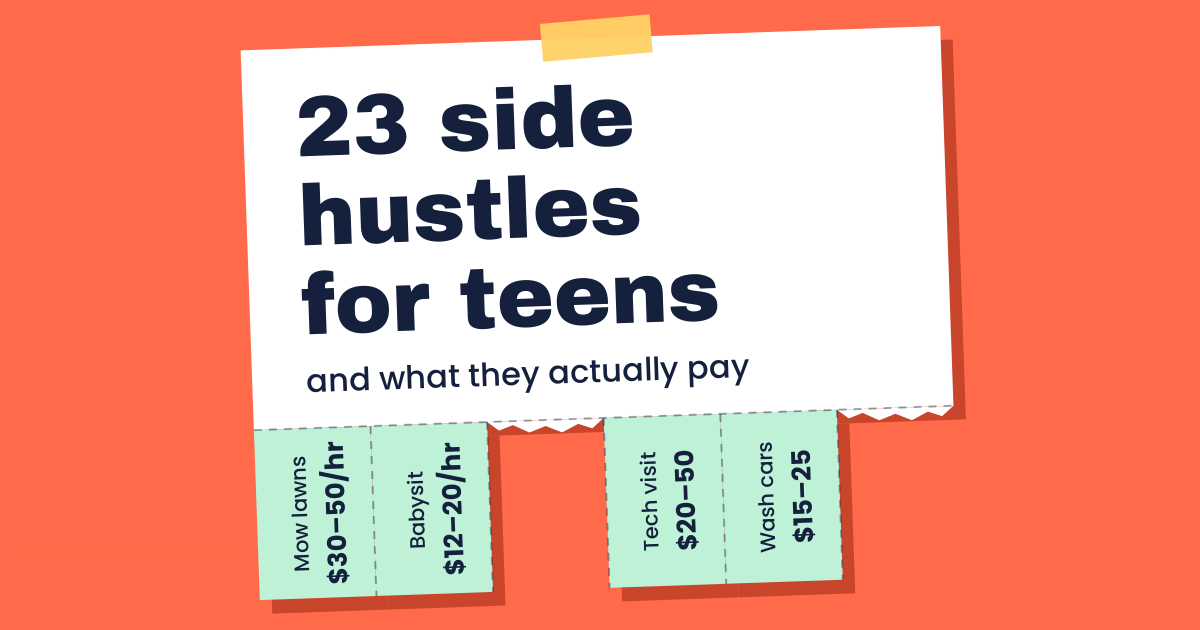
Most “side hustle” advice for teens is either recycled lemonade-stand energy or wildly overhyped promises about turning your phone into an ATM. Neither one is honest about what actually pays or how long it takes to build, or about what’s realistic for someone who’s also got homework and a curfew.
So here’s the honest version: 23 side hustles teens are actually doing in 2026, sorted by how fast you can start, with real pay ranges and the age rules that come with each one. Short on time? The quick-glance table is right below, and the full list follows it.
| Side hustle | Typical pay | Age rule to know | Startup cost |
|---|---|---|---|
| Yard work (raking, weeding, snow) | $15–$30 per job | No minimum; it’s self-employment | Basic tools |
| Car washing and detailing | $15–$25 basic; $60–$120 full detail | No minimum | Under $30 |
| Babysitting | $12–$20 per hour | Most families look for 13+; certification helps | Free to low |
| Dog walking and pet sitting | Modest but steady | Rover and Wag generally require 18+, so go through neighbors | Free |
| Lawn care | $30–$50 per hour of mowing | No minimum, but stick to equipment you’re trained on | Mower access |
| Tech help for neighbors | $20–$50 per visit | No minimum | Free |
| Tutoring | $15–$30 per hour | Platforms like Wyzant require 18+; informal tutoring doesn’t | Free |
| Freelance writing | $15–$50 per project, rising with a portfolio | Platform rules vary; a parent usually needs to be involved | Free |
| Social media management | $100–$500 per month per client | No minimum; a parent should review contracts | Free |
| Reselling and flipping | Often 2–5x what you paid | A parent’s account may be needed for payments | Small |
| Paid surveys | $5–$18 per hour equivalent | Often 13+ with parent approval | Free |
| YouTube or TikTok content | Slow burn; months before real income | A parent or guardian manages monetization | Free to low |
Let’s set expectations first, because most guides don’t.
A single, casual side hustle (think surveys or occasional babysitting) usually nets somewhere in the $30–$150 a month range. Stack two or three consistent gigs, say tutoring plus reselling, and $150–$400 a month is a realistic target. Teens who commit hard to one skill-based hustle, whether that’s freelance design or a resale business, can push past $500–$1,000 a month. That’s the top of the range, though, and it typically takes several months of consistent work to get there.
These are the ones you can start literally today, no skills or startup cash required.
These take a little more reliability and reputation-building, but they pay better and tend to turn into repeat clients.
No driver’s license, no problem. These all work from a laptop or phone.
Both are realistic, but this category has the longest runway, and it’s worth knowing that going in.
These take more initiative but reward it.
Finding the first paying customer is where most teens stall.
Start with your warm network: parents’ friends and neighbors. Strangers online come later. Before anyone asks, decide on a rate. Check what others charge locally and start at the low end if you have no track record, then raise it as your reviews and referrals pile up. Pitch in one sentence a busy adult can say yes to, something like “I’ll mow your lawn every Saturday for $35.” Do the first job better than they expected, then ask, out loud, whether they’d mention you to a neighbor. One happy client usually brings the second.
Keep a running note of what you earn and what you spend, even if it’s just a phone note. You’ll want it at tax time. And give your one chosen hustle about 30 days of real effort before you judge it; most teens who stick with it that long have at least a few paying customers.
Surveys, task apps and “easy money” offers are where teens (and their parents) get burned most often. A few red flags are worth memorizing:
The fake-check scam deserves a closer look, because it fools adults too. Someone hires you for a simple job, then sends a check for more than the agreed price and asks you to return the difference or pass it on to a “supplier.” The check looks real for a few days. The money you sent is gone for good, and when the bank discovers the check was fake, you owe that money back. No legitimate client needs an overpayment returned in gift cards or cash.
If you’ve already replied to something that feels off, stop answering, screenshot the messages and tell a parent right away. If you sent money or shared bank details, call the bank the same day. You can also report the offer to the platform where it showed up and to the Federal Trade Commission at ReportFraud.ftc.gov. Tell someone quickly, because scammers count on people staying quiet out of embarrassment.
When in doubt, run it past a parent before you reply.
Most of these hustles are low-risk with a few ground rules. Check each platform’s age terms, since many require 18 and some let a parent hold the account. Read any agreement before a teen signs it, keep early jobs local, and learn unfamiliar equipment like mowers and pressure washers with supervision first.
Briefly, because this deserves its own read. Child labor laws mostly limit what employers can ask of young workers, so they generally don’t cover a teen running their own babysitting or lawn care gig, but some cities require a business license for services like pet care, so check locally before you advertise.
As for taxes, if your net earnings from self-employment reach $400 in a year, the IRS generally expects you to report them and pay self-employment tax, which is the Social Security and Medicare tax you owe on your own earnings and which an employer would normally split with you, even if you’re a minor. That’s true whether or not a client sends you a 1099 form reporting what you were paid. A parent or tax professional can help you work out what you owe. (For the full legal breakdown, including licensing, taxes and age-by-age rules, see our complete small business guide for teens.)
Pick one. The teens who make real money aren’t the ones juggling five half-started hustles. They’re the ones who picked something that matched a skill or interest they already had, and built from the first paying client.
If you’re not sure where to begin, try this: like being outdoors? Start with yard work or lawn care. Good with kids? Babysitting. The classmate everyone texts for homework help? Informal tutoring. Always fixing other people’s phones? Tech help for neighbors. Love making things? Etsy or digital products. Then start with whichever one on this list made you think “oh, I could actually do that.” That instinct is usually right.