Physical Address
304 North Cardinal St.
Dorchester Center, MA 02124
Physical Address
304 North Cardinal St.
Dorchester Center, MA 02124

Last updated: October 2026
The first time I held a delivery app’s earnings screen up against my gas receipts, I felt like someone stepping on a bathroom scale after a long holiday weekend. The app said $64. My car, my phone plan and, eventually, the IRS had a few objections.
That gap between what the screen says and what lands in your pocket is the real subject of this guide. Below are nine delivery apps still operating in 2026, with their age and vehicle rules, the pay drivers actually report, and the catch each one comes with. Further down, we do the gas-and-tax math that most lists skip, and we answer the questions people actually type into Google: which apps pay daily, which delivery driver jobs work without a car, and which service is the best one to work for.
Short on time? Start here:
Every app below is active, available in multiple US states and open to ordinary drivers. Pay figures come from company statements where they exist, and from driver-tracking and self-reported data where they don’t, so treat every range as a starting point. Your city, your hours and your choosiness will move it.
If delivery apps had a default setting, it would be DoorDash. It’s the biggest of the restaurant-delivery apps, which usually means the most orders and the shortest road from download to first delivery. There’s no commercial license to get and no required vehicle age, and in some areas you can deliver by bike or scooter. Drivers, called Dashers [DoorDash’s name for its couriers], keep 100% of tips, and DoorDash doesn’t require a minimum acceptance rate, so you can turn down weak offers without risking your account.
Is that freedom a trap? A little. Base pay is often small, roughly $2 to $10 or more per offer, so tips and your willingness to decline weak offers do most of the work.
At a glance: 18+ in most states (19 in some, and 21 for new applicants in California) · car, scooter or bike in select areas · weekly direct deposit, or Fast Pay daily for a $1.99 fee · official requirements page
Uber Eats is the most flexible about how you get around. Depending on your city, you can deliver by car, scooter, bicycle or on foot, which makes it the first stop for anyone without wheels of their own. There are no blocks to book: you go online when you want. Couriers can also cash out up to six times a day for a fee, so tonight’s money doesn’t have to wait until next week.
Age rules depend on how you travel. Bike and foot delivery typically starts at 18, car and scooter delivery at 19, and motor-vehicle delivery requires 21 in California and New York. New-courier bonuses come and go, so read the terms before you count on one.
At a glance: 18+ for bike or foot, 19+ for car or scooter, 21+ for motor vehicles in California and New York · Instant Pay up to six times a day for a fee (about $1.75 each, according to a ShiftTracker summary of Uber’s help center) · official sign-up page
Two different jobs share one name here, and the difference matters. Full-service shoppers are independent contractors who shop and deliver. In-store shoppers are part-time Instacart employees who only fill orders inside the store, with no driving and no car required. Full-service shoppers receive a company debit card to pay for the groceries, so you aren’t fronting the bill.
Pay arrives per batch [Instacart’s word for an order or a group of orders], often reported at around $7 to $10 or more plus tips. Is that enough? It depends on the order. You see the batch pay and expected tip before you accept, but a slow store or a long chain of substitutions can eat an hour, so big orders with strong tips are where the money lives. Be ready to lift about 40 pounds.
At a glance: 18+ for both roles · full-service needs a license, insurance, a car and insulated bags or a cooler · in-store needs no car · weekly pay, with a small-fee instant cash-out after your first few batches · official shopper page
Spark is the delivery platform most older lists forgot. You shop or pick up Walmart orders, then deliver them in your own vehicle. Walmart doesn’t always handle hiring directly: in some markets, third-party partners onboard and pay drivers, so the sign-up screens can look different from city to city.
Walmart doesn’t promise an hourly rate. Driver-tracking sites report roughly $15 to $25 gross per hour [gross means before gas and other costs come out] in busy windows, and noticeably less once expenses are counted. Requirement guides list cars, SUVs, minivans and trucks rather than bikes or scooters, so confirm your vehicle type in the app.
At a glance: 18+ (some local partners set a higher minimum) · license, insured vehicle and background check · busiest during morning and early-evening windows · Spark’s help center
Most delivery apps ask you to say yes to a mystery. Amazon Flex does the opposite. You claim blocks (pre-booked delivery shifts, usually three to six hours for Amazon.com orders), and the total pay is shown before you accept. Amazon says most drivers earn up to about $18 to $25 an hour, and you choose which weekday your earnings arrive, with an optional debit card if you want faster access.
Is it too good to be true? Not quite, but it has friction. Some cities keep waitlists, the best blocks vanish quickly, and the vehicle needs to be a four-door car, SUV, van or covered-bed truck. Remember that the published range is before your car’s costs: a long drive to the warehouse and back can quietly shrink a block. Larger vehicles can unlock blocks that pay roughly 15% more, which helps if you already own one and isn’t worth buying one for.
At a glance: 21+, no exceptions · license, insurance, qualifying vehicle and background check · official requirements page
Shipt is owned by Target and delivers groceries and household goods from stores in hundreds of cities. You shop the order, pay with a Shipt-issued card, and drop it at the customer’s door. One perk for newer drivers: you don’t have to own the car you drive, as long as it’s a reliable 1997-or-newer vehicle and you’re insured to drive it.
Gridwise’s 2025 data put the median Shipt shopper at about $17 per active hour, and tips are yours in full. Remember that you’re doing two jobs at once, shopping and driving, and careless substitutions show up in your ratings. Getting in can take anywhere from a few days to a few weeks, because Shipt onboards as needed.
At a glance: 18+ (21 to deliver alcohol) · be ready to lift roughly 45 to 50 pounds · weekly pay on Fridays, or instant cash-out · official requirements page
Grubhub still operates, but it’s a different company than it was a few years ago. Wonder, the food-hall company founded by Marc Lore, bought it from Just Eat Takeaway.com in a $650 million deal that closed in early 2025. So where does that leave drivers? Mostly in a similar place. Grubhub leans on scheduled blocks, and in some markets tops you up to a minimum rate during them, though it doesn’t publish the figure. One quirk to know: you see the tip only after you accept an order.
Gridwise’s 2025 data put the median Grubhub driver at about $15 per active hour, which is competitive on paper but depends heavily on how many orders your market sends. That makes Grubhub work better as a second app than a first in many areas, and best in dense cities with plenty of restaurant partners. If you’re 18, you may need to have held your license for at least a year, and a couple of sources list the minimum age as 19, so confirm in the app.
At a glance: 18+ in most markets, 21+ in Las Vegas · car, scooter or bike depending on the market · weekly pay on Thursdays, or instant cash-out for about $0.50 (free for Chase customers) · driver site
Gopuff delivers snacks, drinks and household essentials from its own warehouses, so every trip starts from one central pickup point instead of bouncing between restaurants. Many drivers work scheduled shifts with an hourly minimum that varies by city, which means a slow hour still pays something.
Gridwise’s tracking of about 950 drivers put the median [the middle figure, so half of drivers earn more and half earn less] at around $15 gross per hour in 2025, with tips making up roughly half of it. Gopuff only runs where it has warehouses, so check that one serves your area before you apply.
At a glance: 21+ · valid license and background check · scheduled shifts
Roadie is a UPS company, and its gigs look different from food or grocery runs. You browse jobs, anything from a pharmacy order to an oversized item heading across the state, and take the ones that suit you. Most local gigs are reported at roughly $8 to $50 each, and long-distance or oversized jobs pay far more. There’s no steady hourly rhythm and heavy items mean heavy lifting, so it suits drivers who prefer a few well-paid trips over a stream of small ones.
At a glance: 18+ · license, Social Security number and background check · weekly pay on Tuesdays, or Instant Pay after your first few deliveries
Not exactly, and the reason is that three different kinds of numbers float around, and they rarely agree.
Company-published figures. Only Amazon Flex publishes an hourly range for drivers: up to about $18 to $25. Everyone else publishes per-offer details, not hourly pay.
Self-reported figures. On Indeed, drivers report roughly $20 to $22 an hour for DoorDash, Uber Eats and Amazon Flex. Those averages come from small samples and are gross, meaning before gas, wear and tax.
Tracker-measured figures. Gridwise, which logs real driving sessions, reported 2025 medians of about $15 an hour for Gopuff, $14 for Uber Eats and $11 for DoorDash, measured on active time only. Solo, another tracker, put the 2026 DoorDash average near $15 per hour of on-trip time. The spread between trackers is partly definitional: one counts only minutes you’re carrying an order, another counts every minute you’re logged in.
So how do you read all this? Self-reported numbers run higher than tracker numbers, and both are gross. Treat roughly $11 to $15 an hour as a realistic starting range for restaurant apps before vehicle costs, and measure your own rate in your first week.
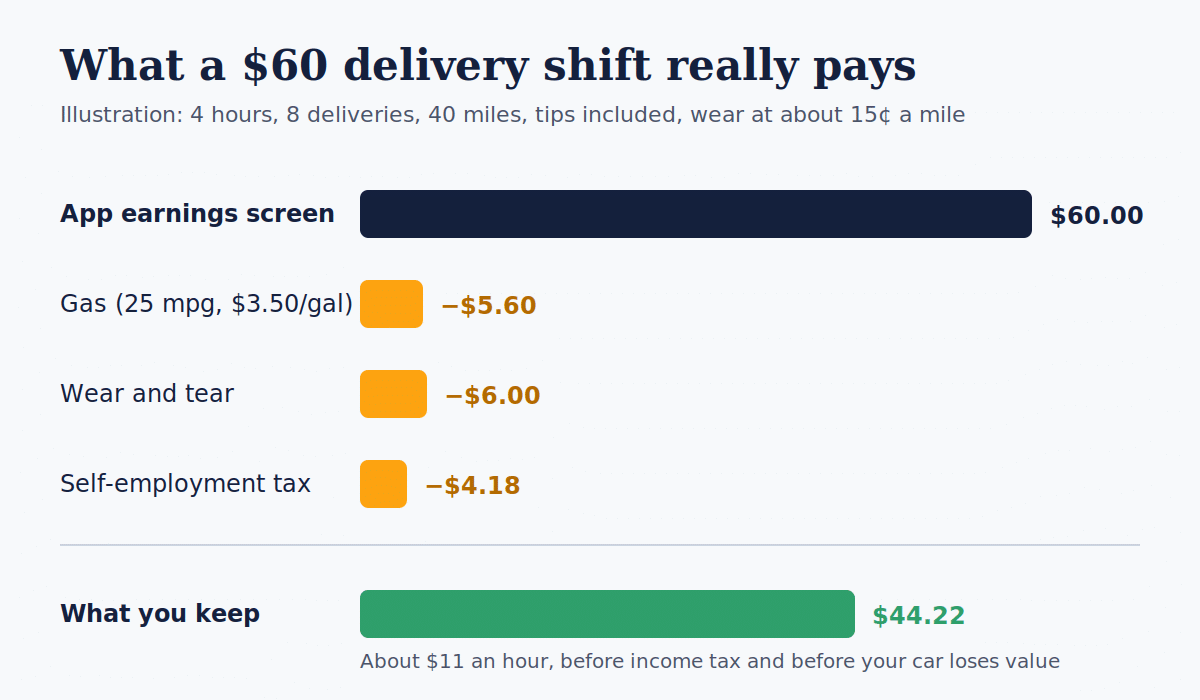
Here’s an illustration, not a statistic. Say you work four hours, complete eight deliveries and drive 40 miles in total. Your earnings screen shows $60, tips included. That’s $15 an hour, which looks respectable.
What’s left is about $44, or around $11 an hour, before any income tax and before counting your car’s slow loss of value. Change my assumptions however you like, but the lesson holds: $15 on the screen can quickly turn into $11 in your pocket.
How does the mileage deduction fit in? As a contractor (you’ll hear the term 1099 worker, after the tax form you receive instead of a W-2), you can deduct business miles when you file. The IRS standard rate was 72.5 cents per mile for the first half of 2026 and rose to 76 cents per mile from July 1. In the example above, 40 miles at 76 cents is $30.40, which lowers your taxable profit from $60 to about $29.60. That deduction is a tax tool, not cash in hand, but it’s the reason tracking every business mile matters so much.
When do you owe self-employment tax? If your net self-employment earnings reach $400 for the year, you generally need to file and pay it, even if the app never sends you a tax form. Because nobody withholds anything from your pay, many drivers set aside a slice of every payout.
This is general information, not tax advice. A tax professional can tell you what applies to your situation.
Waiting a week for money you earned on Tuesday is a hard sell, so this question comes up constantly. Most apps pay weekly by default and offer a faster option, usually for a fee.
Do those fees matter? A $1.99 fee on a $150 cash-out is small. On a $15 cash-out, it isn’t. Treat instant pay as a tool for the occasional tight week, not a daily habit.
Yes, in some places. Several apps let you deliver by bike, scooter or on foot, though it depends on your city.
Spark, Shipt, Amazon Flex, Gopuff and Roadie all expect a car. If you’re going the bike route, check your city’s rules on e-bikes and helmets, and plan for rain, because weather decides your hourly rate faster than any app does.
The basics are surprisingly similar from app to app: a smartphone, a background check, and a license plus car insurance if you’re driving. Age is where they differ.
Vehicle rules are looser than people expect: DoorDash has no strict car-age limit, and Shipt accepts anything from 1997 onward. Amazon Flex is the pickiest, wanting a four-door vehicle.
“Best” depends on what you need, but a few questions separate the good apps from the merely available ones.
Plenty of drivers do, a habit known as multi-apping [running two or more delivery apps at once]. The idea is simple: when one app is quiet, another might send an offer, so you spend less time waiting. The risks are just as simple. Juggling orders can make you late, and late deliveries hurt ratings. Scheduled work like Amazon Flex blocks and Gopuff shifts doesn’t mix well with anything else. And check your local hands-free driving laws before you tap a second app on the road.
If you try it, start small. Pair a restaurant app with a grocery or block-based app instead of stacking two restaurant apps and hoping for the best.
For some people, yes. It’s one of the few side jobs you can start this week, work in small slices, and stop whenever life gets busy. There’s no boss to impress and no interview to rehearse, just a smartphone and a vehicle.
For others, the math never quite works. You’re an independent contractor, so there’s no health insurance, no paid time off and no overtime, and your own car absorbs the wear. Tips fluctuate, offers fluctuate, and the hour that paid $22 on Friday can pay $9 on Tuesday.
One more thing to settle before your first delivery: ask your auto insurer whether your policy covers delivery work. Some personal policies limit or exclude coverage while you’re delivering, and a phone call now is cheaper than a surprise later.
If you’re still deciding on a plan, other ways to earn money is a good next stop, and freelancing websites covers work you can do without a car.
Older lists still recommend all three, so it’s worth a quick correction. Bite Squad was acquired by Waitr and scaled back operations in several cities not long after. Caviar was bought by DoorDash from Square in 2019 for $410 million, so it no longer operates as its own independent opportunity. And Saucey, according to Money Crashers, doesn’t hire drivers directly; it works through partners like DoorDash and Uber Eats. If a list sends you to any of these names, double-check that it’s still taking drivers in your area before you spend an evening on the application.
If you want the simplest start, pick DoorDash or Uber Eats and treat your first week as a trial. Track your hours, your miles and your actual payouts, and compare the totals with what the screen promised. If the numbers hold up, add a second app that fits your schedule. If they don’t, you’ve learned that cheaply.
The best delivery service to work for isn’t the one with the loudest sign-up bonus. It’s the one where, after gas, wear and taxes, the hour still pays what you need it to. Judge every offer by what you’ll keep, not by what the screen says.