Physical Address
304 North Cardinal St.
Dorchester Center, MA 02124
Physical Address
304 North Cardinal St.
Dorchester Center, MA 02124

Writing an open letter is deceptively difficult. The impulse behind one is usually emotional, a genuine grievance, a cause worth defending but the letters that actually get read and acted on are not built on emotion alone. They are built on structure: a named audience, a clear argument, and a request stated plainly enough that a reader with no stake in the issue can still follow it.
This guide walks through that structure step by step, including a full worked example and a fill-in template you can adapt directly.
An open letter is a letter addressed to a specific person or group but written and published for a much wider audience to read. It has one foot in a private letter and one foot in a public speech. It’s addressed to someone specific – a principal, a CEO, a senator, an entire industry but it’s written knowing the “real” audience is everyone else reading over that person’s shoulder.
That dual audience is what trips people up: write only to the recipient and outsiders lose the thread; write only to the crowd and it reads like a rant with a fake “Dear” on top. The best letters do both – specific enough for the recipient, clear enough for a stranger to follow immediately.
Martin Luther King Jr.’s “Letter from Birmingham Jail” is the classic example: addressed to clergymen, written for the country. Teens have used the same format to challenge school policies, question a company’s decisions, or speak to an entire generation.
Fair question. A DM or an email is faster, and if you just want a fast policy answer from one person, send the email instead – you’ll probably get a reply sooner.
An open letter earns its extra effort when the point isn’t really about getting one reply. You’re not just asking a question; you’re putting a position on the record, in public, where other people can see it, agree with it, and rally around it. It creates social pressure that a private message can’t. It also protects you a little, public accountability makes it harder for a recipient to just quietly ignore the issue, because now other people are watching too.
If your goal is “get this one person to answer me,” write an email. If your goal is “make this issue impossible to quietly ignore,” that’s an open letter.
This is the step people skip, and it’s the one that determines whether your letter gets taken seriously or dismissed as noise.
Pick a recipient who can actually act on what you’re asking for : not just someone who’s associated with the issue. “Dear School Administration” is vague enough that nobody feels personally responsible for answering it. “Dear Principal Alvarez” puts the ball in one specific court.
If you genuinely don’t have one clear decision-maker, addressing a group is fine – just make sure the group is defined narrowly enough that it doesn’t dissolve into “everyone, which means no one.”
Strip away the emotion and every effective open letter follows roughly the same skeleton:
Notice what’s not on that list: a long wind-up. The mill-generated “guides” you’ll find online pad this structure out with filler about formatting margins. The structure itself is short on purpose – it’s built to be read in under two minutes by someone who has no obligation to keep reading.
Most effective open letters run 400 to 800 words [about one to two typed pages] — long enough to make a real argument with evidence, short enough that a reader with no personal stake will actually finish it. If you’re posting to social media, plan on a shorter, tighter version, since attention spans there are even less forgiving. If you’re submitting to a newspaper’s letters section, check their specific limit before you write a word — many cap submissions well under 400 words, and going over usually just gets you cut, not edited.
“I am writing to express my concern about…” is the open letter equivalent of throat-clearing before you speak. It’s technically words, but it tells the reader nothing they’ll remember thirty seconds later.
Instead, open with the actual stakes. State the specific problem, in one sentence, using real details instead of vague categories. Compare “There is an issue with cafeteria policy” to “Last Tuesday, the cafeteria ran out of anything vegetarian by 11:40, for the fourth time this semester.” The second one is a sentence a reader can picture. The first one is a sentence a reader skims past.
Passion is the whole reason you’re writing this. But passion without evidence reads as venting, and venting gets scrolled past. The letters that actually move people pair the emotional case with something concrete – a number, a date, a direct quote, a specific policy line.
A few habits that keep a letter persuasive instead of ranty:
Signatures do real work: they turn “one person’s opinion” into “documented, visible support,” which is exactly the leverage a private email can’t give you. A letter with forty signatures under it is a much harder thing to dismiss than a letter with one.
That said, don’t chase signatures before the letter is ready. Circulating a rough draft to build a list, then editing it later, means some signers are agreeing to words that no longer exist in the final version, which gets awkward fast if anyone compares notes. Finalize the letter first. Then share it and ask people to read the whole thing, not just the headline, before they sign.
An open letter with no audience is just a private letter that used bigger words. Depending on who you’re trying to reach:
Pick based on your actual recipient. If you’re addressing your school board, a public Google Doc you can email directly to them, with a shareable link for classmates, usually beats a social post they’ll never see.
Here’s a full example, built on the structure above, so you can see the skeleton actually holding weight:
An Open Letter to Lincoln High School Administration
Dear Principal Reyes,
Last month, three students in my grade missed a full week of school for stress-related illness within the same two-week stretch — and none of them had an excused way to say why.
Our school added two wellness days to the calendar this year, which was a real step forward. But wellness days scheduled months in advance don’t help a student who’s overwhelmed on a random Tuesday in March. Right now, the only way to take a mental health day is to either lie about being physically sick or show up anyway and struggle through it.
I understand the concern: if “mental health day” becomes an easy excuse, attendance policy gets harder to enforce fairly. But several nearby districts have already solved this by allowing a small, fixed number of self-excused wellness absences per semester, no doctor’s note required — and their attendance numbers haven’t dropped.
I’m asking the administration to pilot the same policy here: two self-excused wellness absences per semester, tracked the same way as any other excused absence.
Sincerely, [Student name] [Space for classmates to add their names in support]
Notice it does everything the structure section promised: a named, empowered recipient, a specific detail in the opening instead of a throat-clear, one paragraph per point, the counterargument addressed head-on, and a single concrete ask — not “please do something about this.”
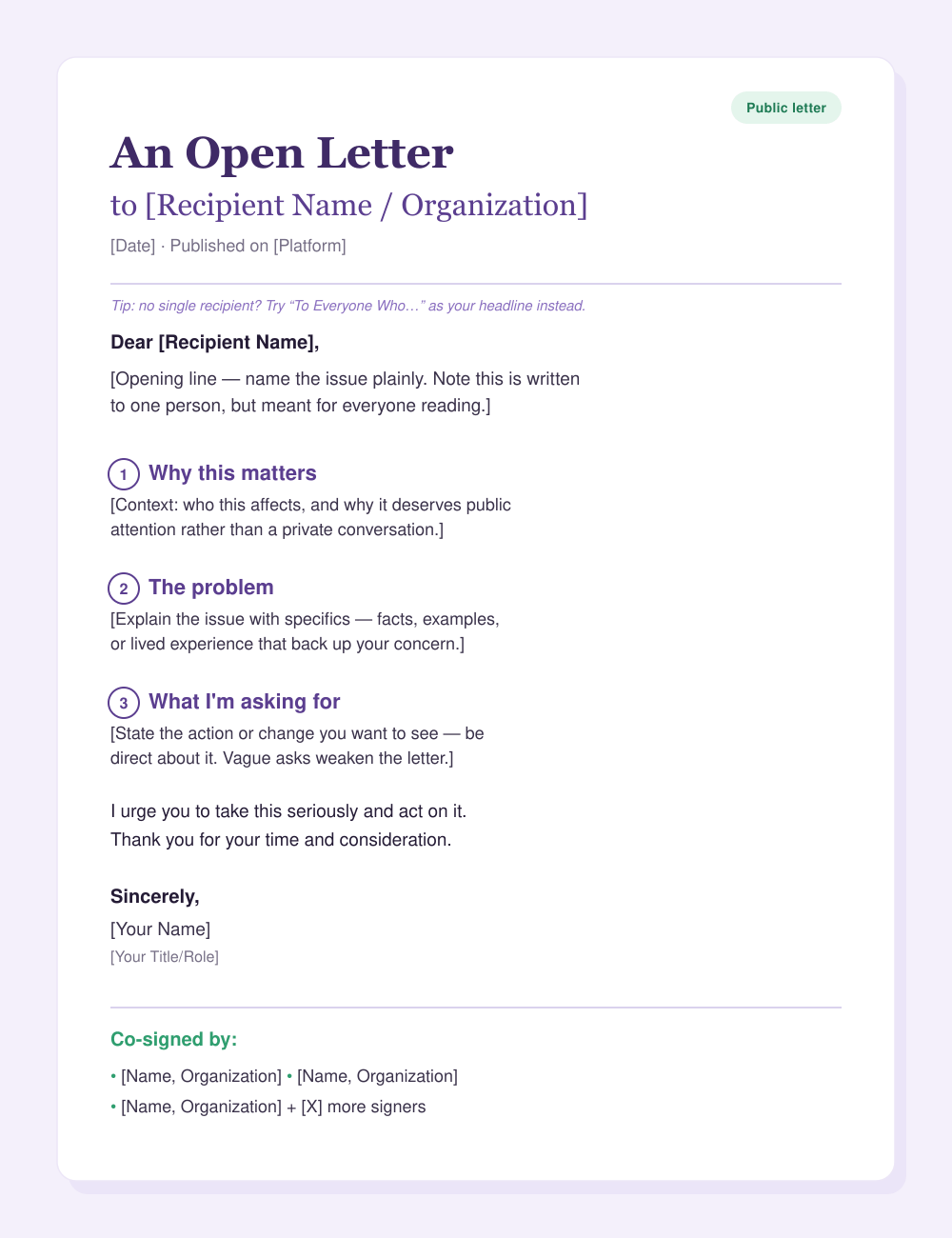
Now here’s the same skeleton stripped down to a fill-in template, for when you’re starting from a blank page:
An Open Letter to [Recipient’s Name/Title]
Dear [Recipient’s Name],
[One sentence stating the specific problem, with a concrete detail — a date, a number, a direct example.]
[Two to three short paragraphs: what’s happening, why it matters, and — briefly — who else it affects besides you.]
[One sentence addressing the most obvious counterargument or “why hasn’t this been fixed already.”]
[Your specific, doable ask. Not “please fix this” — the actual action you want taken.]
Sincerely, [Your name] [Space for additional signatures, if you’re collecting them]
Almost every weak open letter fails for one of the same handful of reasons:
The gap between “person with a strong opinion” and “person whose open letter actually got read” usually isn’t talent. It’s structure. Name a real recipient. Open with something specific instead of a throat-clear. Make one ask, clearly, and mean it.