Physical Address
304 North Cardinal St.
Dorchester Center, MA 02124
Physical Address
304 North Cardinal St.
Dorchester Center, MA 02124

I once organized a trust fall for a team of six. Four people caught me. The other two were checking their phones. I have since retired from the trust fall business, but the bruise taught me something useful: the activity matters less than the match between the activity and the team.
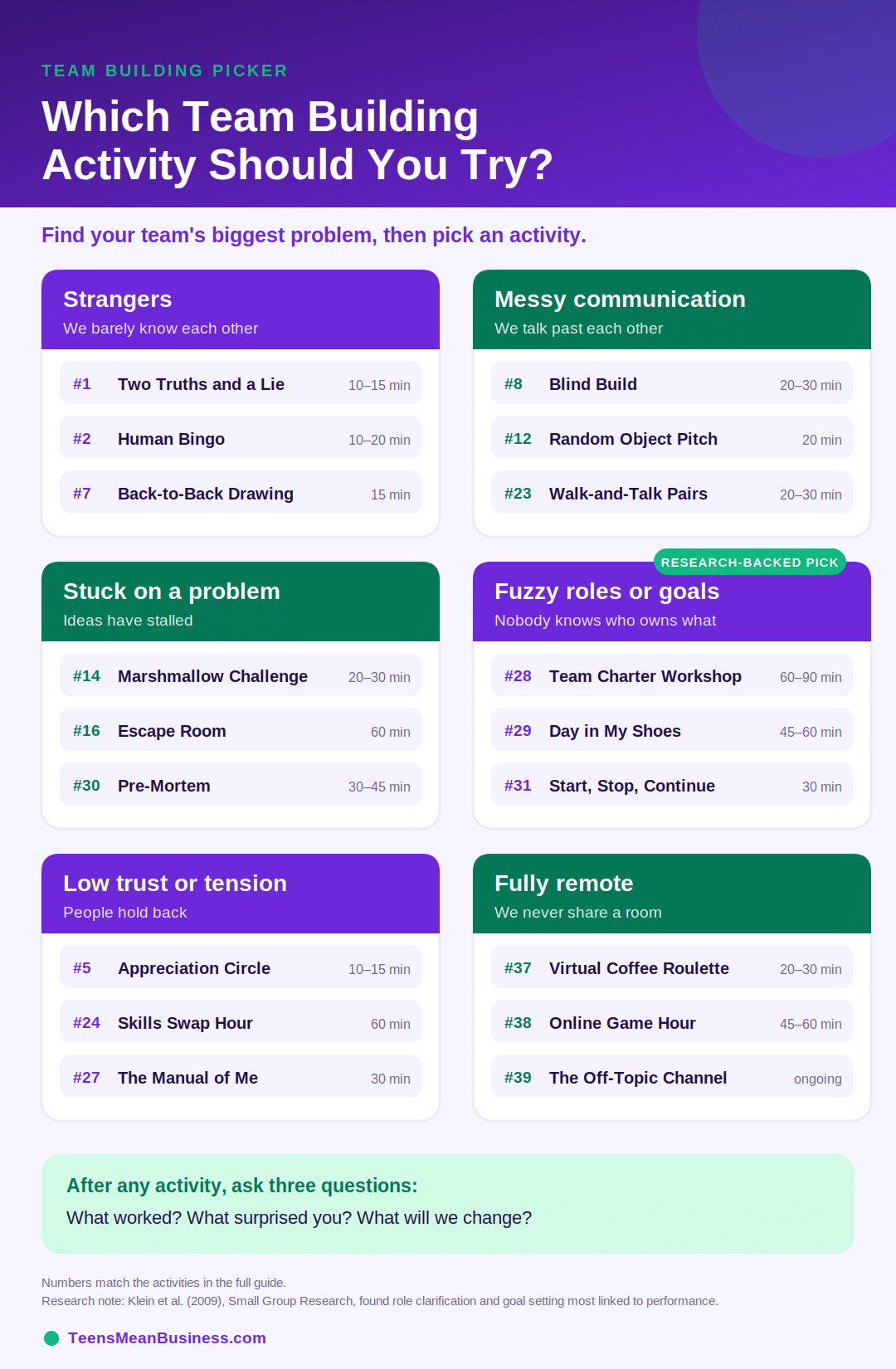
So the list below is sorted by what you actually want to fix: awkward silences, messy communication, stalled projects, fuzzy roles, or a remote team that has never shared a room.
Short on time? Start here.
Every activity lists its time, group size and best use, so you can choose in under a minute.
A team building activity is any structured exercise that helps a group work better together, whether by building trust, sharpening communication, solving a shared problem, or clarifying who does what. It can last five minutes or two days, and it can happen at a desk, in a park or on a video call.
“Structured” is the key word. A pizza party is a nice gesture, but it is not team building unless something in it nudges people to interact differently than they do on a normal Tuesday.
Ask three questions before you pick anything.
What is the problem? Strangers need icebreakers [short, low-pressure activities that help people feel comfortable with each other]. Tense teams need trust and communication work. Stalled teams need a shared challenge. Confused teams need clarity on roles and goals.
How big and how spread out is the group? Most hands-on games work best with 6 to 12 people. Larger groups should split into teams of 4 to 6. Remote teams need activities built for screens, not adapted from the office.
How much do people have to reveal? Sharing a favorite snack is low-stakes. Sharing a failure is high-stakes. Start low and build up. Skipping straight to the deep end is how you end up with two people on their phones.
Now, the activities.
Icebreakers get a bad reputation because people use them as the whole plan. As a warm-up, they are among the cheapest and most effective tools you have.
Time: 10–15 min | Group size: 4–15 | Best for: new teams, onboarding
Each person shares three statements about themselves, two true and one false, and the group guesses the lie. The best “truths” are the ones nobody would believe, like the colleague who once lived on a boat. Keep statements personal but not private, and let people pass.
Time: 10–20 min | Group size: 8–30 | Best for: large groups, events, all-hands
Hand everyone a bingo card where each square describes a trait, such as “has run a marathon” or “speaks three languages.” People mingle and find a different person for each square. First to complete a row wins. It forces conversations between people who would never cross paths otherwise.
Time: 15–20 min | Group size: 4–12 | Best for: new teams, remote teams
Ask everyone to bring (or grab from their desk or home) one object that says something about them, then explain it in 60 seconds. A worn paperback, a chipped mug, a ticket stub. People talk about something other than work, and it runs easily on video.
Time: 5–10 min | Group size: any | Best for: meeting warm-ups
Ask silly-but-work-flavored questions: “Would you rather answer every email by voice note or by carrier pigeon?” Have people move to opposite sides of the room, or vote in chat. Short, loud and low-pressure.
Time: 10–15 min | Group size: 4–12 | Best for: end of a project, tense stretches, remote teams
Go around the group and have each person name something a teammate did that helped them recently. Specific beats generic: “Priya caught the error in my report before the client saw it” lands better than “Priya is great.” It is free, it works on video, and it is one of the few activities people ask to repeat.
Time: 5–10 min | Group size: 3–10 | Best for: weekly check-ins
Each person shares a rose (something going well), a bud (something they are looking forward to) and a thorn (something that is hard right now). It gives people a routine, safe way to be honest about difficulty without turning it into a confession.
Debrief prompt for this section: “What did you learn about someone today that you did not know this morning?”
Most workplace friction is not disagreement. It is two people picturing different things and assuming they are picturing the same thing. These games expose that gap in a way that is funny instead of painful.
Time: 15 min | Group size: pairs | Best for: communication, clarity
Partners sit back to back. One holds a simple drawing and describes it without naming the object. The other draws what they hear, then they compare. The gap between the two drawings is a vivid lesson in how much we leave out when we explain things.
Time: 20–30 min | Group size: teams of 4–6 | Best for: communication, leadership
One person (the “builder”) has a pile of building blocks and cannot see the model. Another (the “describer”) can see the finished model but cannot touch the blocks. They talk, the builder builds, and everyone else observes. Rotate roles. Teams quickly discover who over-explains, who goes quiet and who asks good questions.
Time: 10–15 min | Group size: 6–12 | Best for: problem-solving, physical icebreaker
Everyone stands in a circle, reaches across and grabs two different hands. Without letting go, the group untangles into a circle. It rewards patience and verbal coordination. Inclusion note: skip it if anyone has mobility or comfort concerns, and never make it mandatory.
Time: 10 min | Group size: 8–20 | Best for: nonverbal communication
Ask the group to line up by birthday, month and day, without speaking. They will invent gestures and a system in about ninety seconds. Afterward, ask what strategy emerged. The answer is usually “someone took charge,” which opens a good conversation about informal leadership.
Time: 10 min | Group size: 6–15 | Best for: learning names, building rhythm
Stand in a circle. Throw a ball to someone while saying their name, and they throw it on to someone else. Once a pattern is set, add a second ball, then a third. By ball three it feels chaotic, which is the point: the group has to communicate under pressure.
Time: 20 min | Group size: 4–12 | Best for: creativity, presenting
Pull ordinary objects from a bag. Each person has two minutes to pitch theirs as a revolutionary product. Laughter is guaranteed, and so is a little practice in persuasion.
Time: 15–30 min | Group size: teams of 4–6 | Best for: listening, clear instructions
Everyone closes their eyes (or wears a blindfold) while the team passes a rope around so everyone holds a section. Without looking, they must form a perfect square, then open their eyes and see how close they got. It is a listening exercise in disguise. Inclusion note: closed eyes work as well as blindfolds, and some people prefer them.
Debrief prompt for this section: “Where did the message get lost, and what would have helped?”
These work best when stakes are low, time is short and the task is odd enough that nobody has an obvious head start.
Time: 20–30 min | Group size: teams of 3–5 | Best for: collaboration, iteration
Teams get 20 sticks of dry spaghetti, a yard of tape, a yard of string and one marshmallow. They have 18 minutes to build the tallest freestanding structure with the marshmallow on top. The exercise, popularized by designer Tom Wujec, tends to reward teams that test early and often instead of planning for ages and assembling at the last second.
Time: 30–45 min | Group size: teams of 3–5 | Best for: creative problem-solving
Give each team limited materials (straws, tape, paper, cotton balls) to protect a raw egg dropped from a set height. Set a budget and a time limit, and add a short “design review” where teams explain their thinking before the drop. Do it outside, or put down a tarp.
Time: 60 min | Group size: 4–8 per room | Best for: collaboration under pressure
A classic for a reason. Teams solve linked puzzles to escape within an hour. Notice who spots patterns, who organizes and who quietly solves the hardest clue. Choose a room with cooperative puzzles rather than ones that reward a single genius. Prices vary by city, so check local rates.
Time: 30–60 min | Group size: teams of 3–5 | Best for: mixing departments
Create a list of tasks and finds: a photo with someone from another department, a coworker’s most-used mug, the oldest object in the building. Mix teams across departments for best results, and award points for creativity as well as speed.
Time: 45–60 min | Group size: teams of 4–6 | Best for: competition, social energy
Run a quiz with topics from general knowledge to company history. Mix the teams on purpose so people sit with colleagues they rarely talk to. Add a round about teammates (“Who on the team has visited the most countries?”) to make it personal.
Time: 30 min | Group size: teams of 3–5 | Best for: planning, budgeting
Give each team paper, tape and a few coins. The task is to build a bridge between two desks that holds the most weight. Put “prices” on materials to introduce budgeting. It is a low-cost cousin of the marshmallow challenge and works in any meeting room.
Time: 20–30 min | Group size: teams of 2–4 | Best for: delegation, time management
Each team gets 10 to 15 minutes to design the best long-distance paper plane (and name their airline). Then fly them down a hallway. The tight deadline shows how teams divide work and handle disagreement about design.
Time: 30 min | Group size: teams of 4–6 | Best for: consensus decision-making
Give teams a list of 15 items salvaged from a sinking boat and ask them to rank the items by importance for survival. First everyone ranks alone, then the team has to agree on a shared ranking. Compare how individual rankings differ from group rankings, and discuss how the group reached agreement.
Debrief prompt for this section: “What did we do in the first two minutes, and would we do it again?”
Trust cannot be forced, and anyone who says otherwise has probably never met a team. These activities make trust more likely by creating small, safe moments of honesty, the raw material of psychological safety.
Time: 90–120 min | Group size: 6–20 | Best for: relaxed bonding
Cooking together flattens hierarchy quickly, because the CEO and the intern are equally bad at folding dumplings. If the budget is tight, run a potluck where everyone brings a dish tied to their family or culture and shares the story behind it. Ask about dietary needs and allergies first.
Time: 20–30 min | Group size: pairs | Best for: one-to-one connection
Pair people randomly and send them on a short walk with two or three prompts: “What was your first job?” “What are you working on that you are proud of?” Side-by-side conversation feels less intense than sitting across a table, so people open up more easily. Remote teams can do it as a phone call while each person walks.
Time: 60 min | Group size: 6–20 | Best for: learning, respect across roles
Each person teaches a skill in ten minutes: a spreadsheet shortcut, a knitting stitch, a three-chord song. Colleagues see each other as capable in new ways, and quieter teammates often shine. Rotate who goes first so it never becomes a performance contest.
Time: Half to full day | Group size: 6–30 | Best for: shared purpose
Volunteering at a food bank, park clean-up or school gives a team a common purpose that has nothing to do with quarterly targets. Let the team help choose the cause, and make it paid work time rather than weekend overtime.
Time: 20–30 min | Group size: 6–25 | Best for: diverse or global teams
Put up a world map and give everyone a pin. Each person marks where they were born, where they grew up or a place that shaped them, then shares a short story. Distributed teams can use a shared online map. It is a quiet, respectful way to show how many different paths led to the same table.
Time: 30 min | Group size: 4–12 | Best for: working-style clarity
Everyone writes a one-page “user manual”: how I like to receive feedback, when I do my best work, what stresses me out, how you can tell I am overloaded. Share in pairs or as a group. It turns invisible preferences into visible information and prevents a lot of avoidable friction.
Debrief prompt for this section: “What is one thing you will do differently with a teammate after today?”
This is the section that separates team building that feels good from team building that changes how work gets done. If your real problem is “we keep stepping on each other” or “nobody knows what we are aiming for,” start here.
Time: 60–90 min | Group size: 4–12 | Best for: new teams, reorganized teams
Together, write a one-page charter [a short written agreement about what the team exists to do and how it will work]. Cover purpose, goals for the next quarter, decision rights, meeting rhythms and how conflict will be handled. Post it where people can see it and revisit it every quarter. Teams that write their own rules are more likely to feel ownership of them.
Time: 45–60 min | Group size: 4–10 | Best for: cross-functional understanding
Each person explains what a typical week looks like, what their hardest tasks are and what they wish others understood. Colleagues ask questions but cannot offer fixes in the first round. Sales learns what support actually handles. Engineering learns why marketing keeps asking for “just one small change.”
Time: 30–45 min | Group size: 4–12 | Best for: project kickoffs
Before a project starts, imagine it has failed spectacularly. Each person writes down why it failed, then the group shares and ranks the risks. Because the failure is imaginary, people feel free to name worries they would normally keep to themselves. Then plan how to prevent the top three.
Time: 30 min | Group size: 4–12 | Best for: retrospectives, resets
On sticky notes, each person writes what the team should start doing, stop doing and continue doing. Group them, discuss and pick no more than three changes. It is a lightweight retro (short for retrospective, a regular meeting where a team reviews what worked and what did not). Follow up in a month, or it becomes theater.
Time: 30 min | Group size: 4–12 | Best for: shared purpose, project starts
Give the team a fill-in-the-blank: “We help [who] to [do what] by [how], so that [why it matters].” Everyone drafts their own version silently, then the group compares and merges them into one. Disagreements in the drafts are the point: they show where people’s picture of the team’s purpose differs.
Debrief prompt for this section: “Which decision will be easier next week because of what we agreed today?”
Getting out of the building changes the mood immediately, and it removes the screens that compete for attention. Always check weather, access and accessibility before committing.
Time: 90–120 min | Group size: 12–40 | Best for: large groups, energy
Run relay races, a sack race, a three-legged race and a tug-of-war between mixed teams. Keep the games silly, award points for sportsmanship and offer non-physical roles (scorekeeper, photographer, cheer captain) so everyone can take part without pressure.
Time: 60 min – half day | Group size: 4–25 | Best for: relaxed bonding, wellbeing
Pick an easy trail or a city walking route and set a shared goal, such as total steps or reaching a lookout together. Pair people differently for each leg so everyone talks to someone new. Choose a route that is accessible for all fitness levels, with a shorter alternative.
Time: 90–120 min | Group size: 6–30 | Best for: social energy, low prep
Low-skill sports let beginners and experts mix without embarrassment. Rotate teams between rounds. Hold it during work hours, since evening events exclude people with caregiving duties.
Time: 2–3 hours, then ongoing | Group size: 5–20 | Best for: shared ownership
Plant a garden bed, herb planter or tree at the office or a community site. The activity is short, but the garden gives the team something to tend together over months, which a one-off event cannot.
Debrief prompt for this section: “What did you notice about how we worked together when we were not at our desks?”
Remote teams do not need office activities moved onto a screen. They need activities designed for the screen, which usually means shorter, more focused and often more personal. Schedule them during normal work hours and across time zones fairly.
Time: 20–30 min, ongoing | Group size: pairs | Best for: remote and hybrid teams
Use a tool, or a simple spreadsheet, to pair two random colleagues every week or two for a casual video chat with no agenda. Over a few months, it builds the connections that office hallways create by accident.
Time: 45–60 min | Group size: 4–10 per team | Best for: remote energy boost
Book a virtual escape room, run an online trivia game or try a collaborative drawing game. Keep sessions under an hour, make cameras optional and make attendance voluntary. Remote fatigue is real, so protect people’s time.
Time: ongoing, a few minutes at a time | Group size: any | Best for: informal connection
Create a chat channel for book recommendations, recipes, pet photos and weekend plans, with notifications set low so it never feels like a distraction. It recreates the “chat by the coffee machine” that remote teams lose.
Time: 30 min | Group size: 5–20 | Best for: learning, visibility
Once a month, one teammate presents something they know: a tool shortcut, a lesson from a recent project, a book that changed how they work. Rotate presenters and send lunch vouchers if the budget allows.
Debrief prompt for this section: “What would make this feel less like another meeting?”
A little structure turns a one-off event into something that works.
Small and frequent beats large and rare. A five-minute check-in every week does more for a team than an annual retreat nobody remembers by March. A reasonable rhythm for many teams: a quick icebreaker or check-in weekly, a skills or problem-solving activity monthly, and a longer session (like a charter workshop or volunteer day) once or twice a year.
A few things reliably turn team building into a groan:
Most of the activities above cost little or nothing: icebreakers, communication games, charters, pre-mortems and retros need only time and a facilitator [the person who guides the activity and the conversation afterward]. Low-cost options like the marshmallow challenge or egg drop cost a few dollars in supplies. Escape rooms, cooking classes and outdoor events carry per-person fees that vary widely by location and provider, so get quotes before you commit.
Choose the activity based on what your team needs, not what sounds fun in a meeting. New group? Start with an icebreaker. Messy communication? Try back-to-back drawing. Fuzzy roles? Run a charter workshop. Then keep going, because team building is less an event than a habit.
And if you are tempted by the trust fall, take it from someone who has fallen: let your team catch each other in smaller ways first.